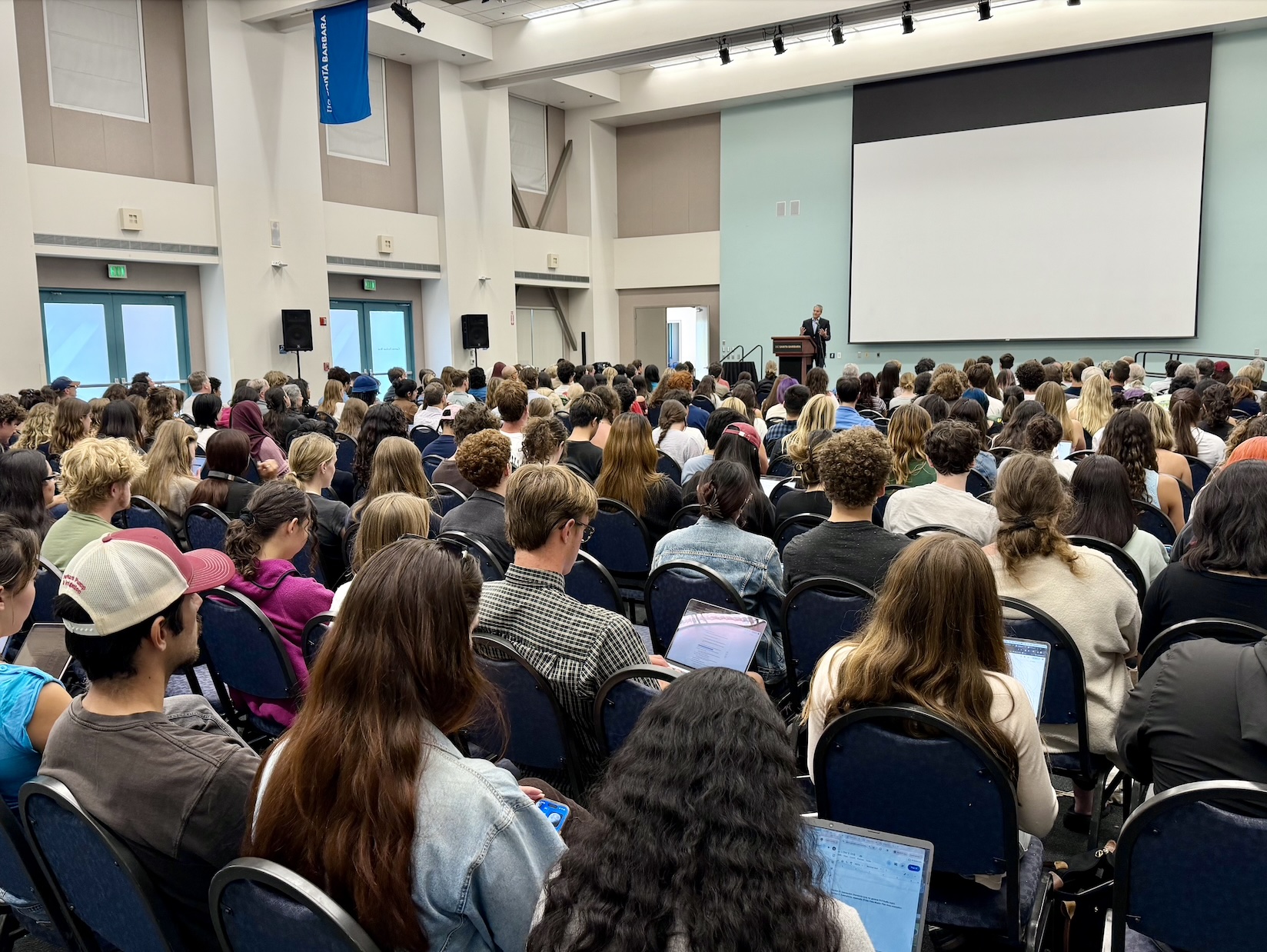
A lecture by California Natural Resources Secretary Wade Crowfoot and the inaugural meeting of the Santa Barbara Wildfire Resilience Collaborative brought state policy, university research and community planning into the same conversation.
On the South Coast, wildfire is not an abstract climate problem.
It is smoke over a neighborhood. A closed road. An evacuation order. A ridgeline under watch. It is also a question that reaches into classrooms, research labs, county offices and community meetings: How does a region learn to live with fire before the next crisis begins?
Over two days in May, that question came into focus at Corwin Pavilion, where California’s climate ambitions met the local work of preparing a fire-prone region for a hotter, more volatile future.
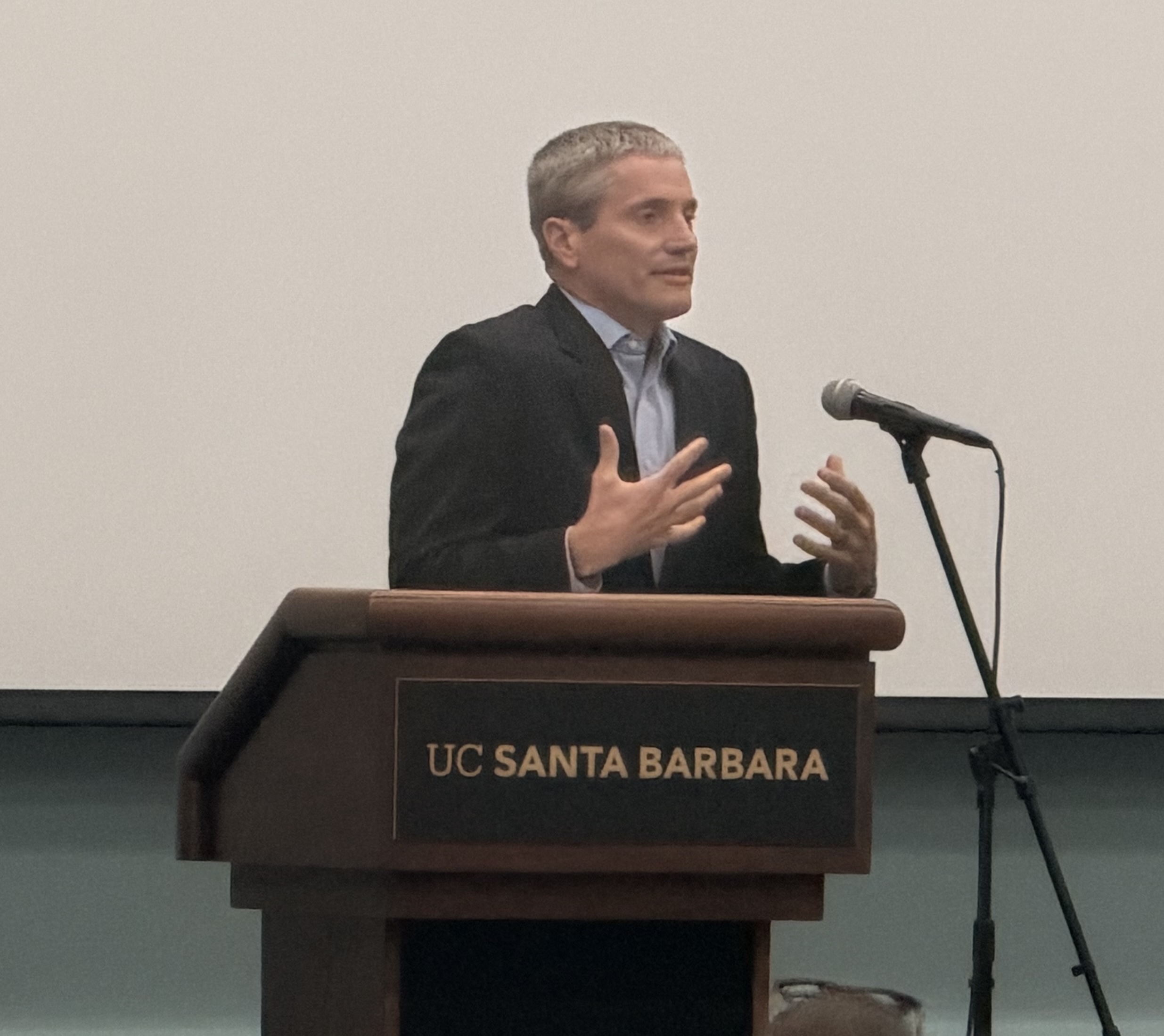
The sequence began May 6 with the 42nd annual Steven Manley Memorial Lecture, organized and hosted by the Environmental Studies Program and held in partnership with the Wildfire Prevention and Policy Lecture Series, featuring California Natural Resources Secretary Wade Crowfoot. It continued May 7 with the inaugural meeting of the Santa Barbara Wildfire Resilience Collaborative, a countywide effort to bring wildfire resilience work into closer alignment across the region.
Together, the events became more than a lecture and a workshop. They offered a view of what a public research university can do in a changing climate: bring people into the same room, connect science with policy and help turn shared concern into coordinated action.
A bridge between science and policy
Sarah Anderson, interim dean and professor at the Bren School of Environmental Science & Management, framed Crowfoot’s visit as part of that larger institutional role.
“This lecture to me serves as a really powerful reminder of the work that we have to do on campus and here at the intersection of policy and the science that we do,” Anderson said. “It is a matter of real-world application and bridging communication.”
That bridge was central to Crowfoot’s lecture, “Confronting Crises: Helping People and Nature Thrive in the Age of Climate Change.” Appointed by Gov. Gavin Newsom in 2019, Crowfoot oversees the California Natural Resources Agency, a 25,000-employee agency responsible for protecting and managing the state’s natural resources. His work spans wildfire, water, conservation and public lands — systems increasingly strained by climate change.
“For many of the last eight years, it’s felt a little bit like practicing emergency room medicine for the environment,” Crowfoot said.
He described a California already living with climate extremes: catastrophic fire, prolonged drought, severe heat and sudden swings between dry and wet years. In the last decade, he said, 10% of the state has burned, much of it catastrophically.
“We live on a beautiful, incredible planet at the perfect time,” Crowfoot said. “Billions of years of evolution have created these Goldilocks conditions that have propelled this human adventure forward for our species. But at the same time, our planet is in a dangerous crisis.”
The danger, he said, is made harder to grasp because many people experience natural systems as something separate from daily life. Forests, rivers, oceans, soils and the atmosphere can seem distant — until smoke, drought or heat makes them impossible to ignore.
“These natural systems are our life systems,” Crowfoot said. “We have built societies that feel very separate from our natural systems, reinforced by a mindset that we are separate from these natural systems.”
In California, that separation has become increasingly difficult to maintain. Wildfire smoke has changed summer routines. Drought has forced millions of residents to rethink water use. Heat waves have tested communities and infrastructure.
“The more I do this work, the more I realize we are that proverbial frog in boiling water,” Crowfoot said. “We are living on a planet that is dangerously out of balance.”
Climate urgency, California action
Crowfoot’s lecture was a warning, but it was also an argument for action. California, he said, has an opportunity to show what climate leadership can look like at scale.
He described the state’s movement toward carbon neutrality, its clean energy mandates and its investments in nature-based solutions — the restoration of forests, wetlands, soils and other landscapes that can store carbon while reducing risk. But he also emphasized adaptation. The work ahead extends beyond reducing future emissions; it also means preparing people and places for the impacts already underway.
“We have our work cut out for us,” Crowfoot said. “And I think first and foremost is to recognize that and to always be led by the science and be clear-eyed on the science.”
That message resonated on a campus where researchers, students and public partners are asking what climate change means in practice — for landscapes, communities and policy.
“Having him here is a truly amazing opportunity to look at that science-to-policy agency transition that we really strive for here at UCSB,” Anderson said. “And it’s not an abstract goal. It’s manifested in a lot of partnerships.”
The next day, that idea moved from the lecture stage to the workshop table.
Building resilience before the fire
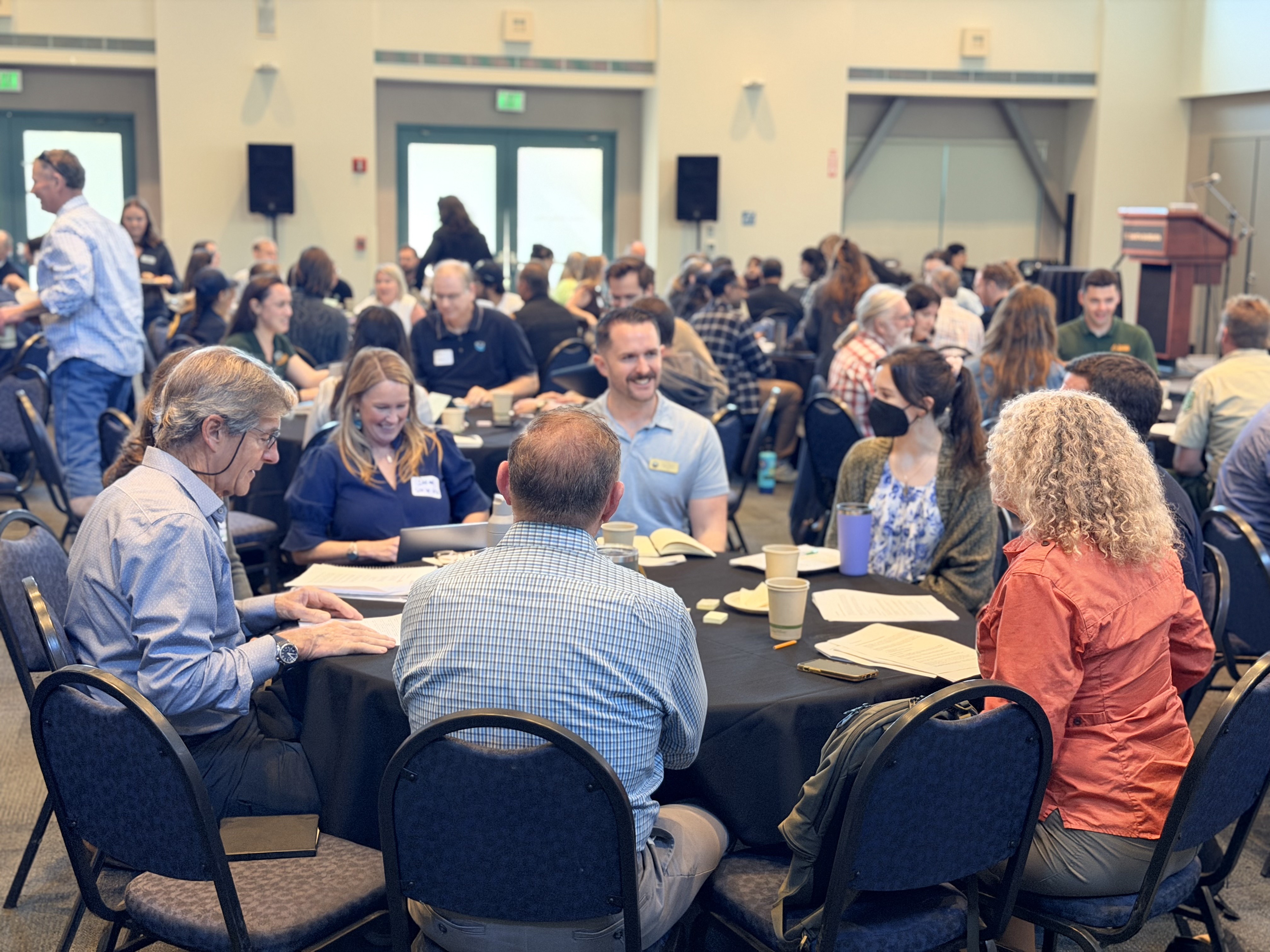
At the inaugural meeting of the Santa Barbara Wildfire Resilience Collaborative, participants gathered around tables rather than in rows facing a podium. The format reflected the purpose of the day. This was meant to be a working session, a place to identify priorities, surface gaps and begin building a shared structure for action.
Across Santa Barbara County, wildfire resilience work is already happening in many forms. Fire agencies prepare for response. Neighborhood groups work on defensible space. Researchers study risk, ecology and communication. Local governments plan across boundaries that fire does not recognize.
The collaborative was created to bring those efforts closer together. A vegetation management project, an evacuation plan, a student research question and a community preparedness effort may all point toward the same goal. Without coordination, they can remain parallel. With coordination, they can strengthen one another.
The questions guiding the day were practical and complex. What does wildfire resilience mean in a county that includes the South Coast, the Santa Ynez Valley and the Sisquoc? How can agencies and communities communicate across technical and jurisdictional boundaries? How can the region move from identifying challenges to addressing them together?
For students and early-career researchers, the meeting offered a glimpse of applied science in motion. Graduate students, postdoctoral scholars and faculty joined conversations with practitioners and public agencies, creating space for research questions to emerge from community needs rather than from theory alone.
That is where the university’s scientific strengths become especially valuable. Through efforts such as the Wildfire Resilience Initiative, researchers are studying how fire moves through landscapes, how communities prepare and how science can inform decisions before disaster strikes. The work draws on expertise across campus, including Geography, environmental science and community planning — and on students and researchers who can move between those worlds.
The May 7 meeting invited those intersections to happen in real time. Participants discussed current wildfire work across the county, identified needs in technical support and outreach, and considered projects that could benefit from new partnerships. By the end of the day, the conversation had turned toward next steps and possible working groups for the year ahead.
The gathering also carried the weight of lived experience. Several participants spoke from the perspective of communities that have faced evacuations, dangerous winds and the uncertainty of whether homes would survive. Their stories grounded the day’s technical discussions in something immediate. Wildfire resilience is not just a matter of maps, models or policy frameworks. It is what happens when residents, firefighters, land managers and local officials meet the same emergency from different vantage points.
Crowfoot made a similar point in his lecture. California, he said, has one of the world’s most sophisticated wildland firefighting forces, but response alone is not enough.
“Wildfire is a great example of where we have to do so much more than respond,” Crowfoot said. “We have to bring back health to our landscapes.”
That means restoring ecological processes, creating fuel breaks near communities, hardening homes and investing before disaster strikes. It also means reckoning with the legacy of fire suppression.
“We have a hundred years of agencies like mine trying to eliminate fire off the landscapes,” Crowfoot said.
The consequences of that history, combined with rising temperatures and drought, are now visible across the state.
“As temperatures increase and as we experience these droughts, they catch fire and the results are catastrophic,” he said.
But the two-day gathering suggested a different model — one centered on preparation, implementation and relationships.
The Environmental Studies Program’s Steven Manley Memorial Lecture brought a statewide leader to campus to speak about climate, science and adaptation. The Santa Barbara Wildfire Resilience Collaborative brought local partners together to begin building a structure for regional action. One event looked outward to California’s role in a global crisis. The other looked inward to the county’s own terrain and communities.
Together, they reflected the work the university is positioned to advance: connecting discovery with decision-making, students with practitioners, and regional challenges with the science and policy needed to meet them.
Fire resilience is built long before smoke appears on the horizon. It is built in research partnerships, public meetings, student training, agency coordination and neighborhood preparedness.
Over those two days, that work began with a shared recognition: The next wildfire will not be met by one agency, one discipline or one community alone. Preparing for it will require all of them — long before smoke is visible on the horizon.
Photos: Eric Zimmerman / UC Santa Barbara