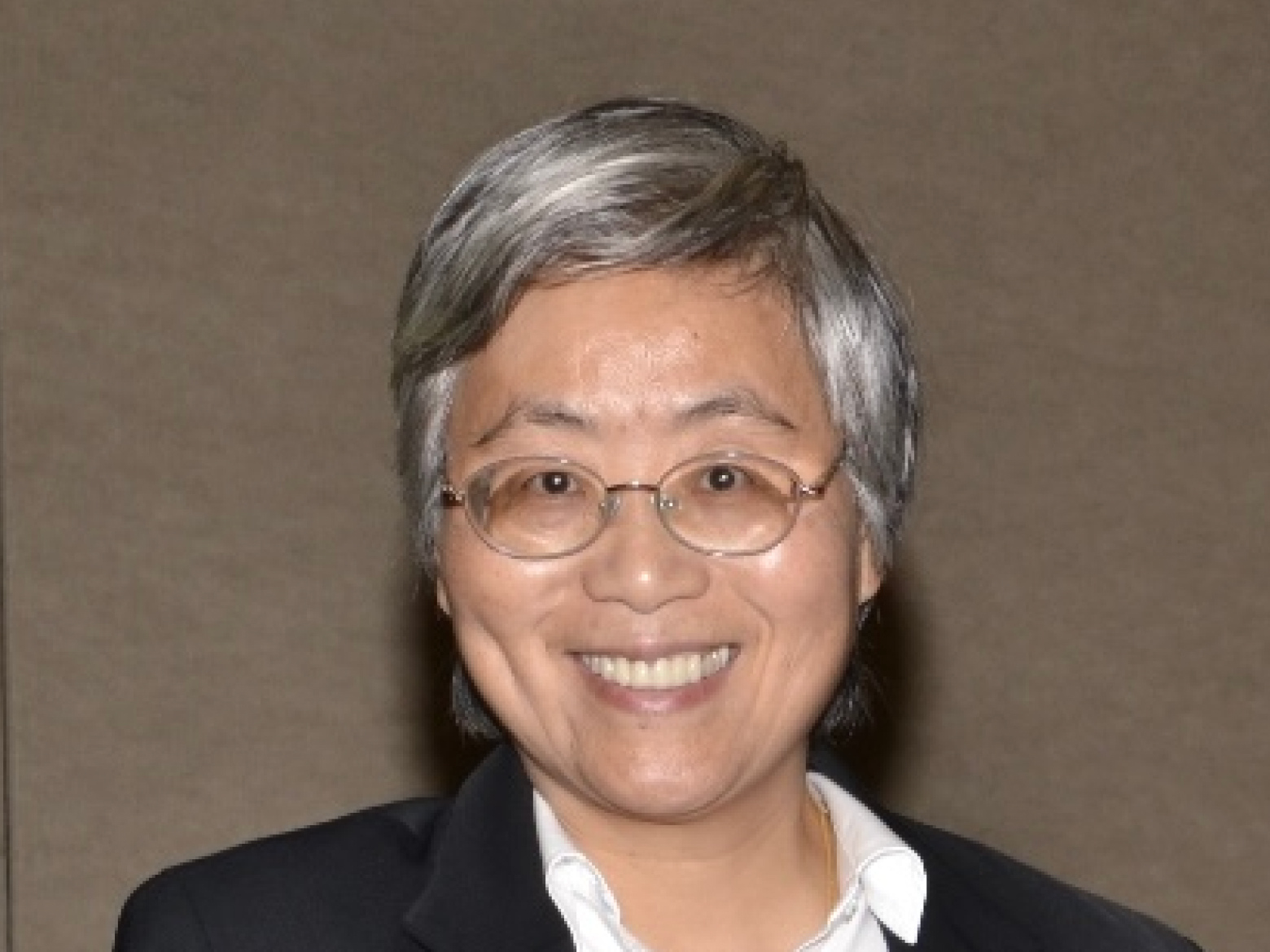
Pictured above: Annie Qu, founding director of the Center for Statistical Foundations of AI and professor of statistics and applied probability at UC Santa Barbara. Courtesy of Annie Qu.
UC Santa Barbara’s new Center for Statistical Foundations of AI develops statistical methods that help researchers quantify uncertainty, test reliability and determine whether AI findings generalize beyond the data used to train a model.
As artificial intelligence becomes increasingly embedded in scientific research, health care and everyday decision-making, a model’s ability to produce an answer is only part of what matters. Researchers also need to know how certain that answer is, how the system performs when data are incomplete or unfamiliar, what factors shaped the result and whether the same approach will work across different people and settings.
The newly established Center for Statistical Foundations of AI, or CSFAI, brings together researchers across statistics, computer science, engineering, biology, brain science, environmental research and other fields to develop artificial intelligence that is more reliable, interpretable and responsive to real-world complexity.
While much AI research focuses on building more capable models, CSFAI concentrates on the statistical foundations that determine whether those models can be trusted: how to quantify uncertainty, test reliability and determine whether findings generalize beyond the data used to train them.
Established May 15, 2026, the center is based in UC Santa Barbara’s Department of Statistics and Applied Probability. It is led by founding director Annie Qu, a professor of statistics and applied probability whose research spans personalized medicine, mobile health, wearable devices, causal inference and statistical learning.
“Computation makes AI possible; statistical reasoning makes AI trustworthy,” Qu said. “Statistics helps us understand not only what AI predicts, but also why it predicts it, how certain we should be and whether those conclusions apply beyond the data used to train the model and how they should guide decisions for individuals rather than populations alone.”
Making AI’s limits visible
Statistical foundations help researchers evaluate not only what an AI system predicts, but also how much confidence to place in the prediction and where the system’s limits may lie.
That includes methods for measuring reliability, quantifying uncertainty, distinguishing causation from association, protecting sensitive information and understanding how a model reached a result. It also includes methods for working with heterogeneous data, or information that varies across people, populations, formats, sources and collection schedules.
These challenges become especially important when AI is used in high-stakes settings, particularly when data come from multiple sources, populations and modalities. A health model, for example, may need to combine laboratory measurements, medical records, images, wearable-device data and patient-reported information collected at irregular intervals. Statistical methods can help researchers determine whether the system is learning meaningful patterns, whether its predictions apply to a particular patient and when the available evidence is too limited for a confident recommendation.
One example comes from Qu’s research using data from Oura smart rings to study physiological stress and physical activity during pregnancy. Rather than relying only on an average pattern across participants, researchers used individualized statistical models to examine how the relationship between activity and stress varied by person and over time.
The study found that physical activity was associated with the greatest reductions in physiological stress on higher-distress days. The work, detailed in a UCSB Science feature on smart-ring data and personalized exercise guidance during pregnancy, illustrates how population-level averages can obscure meaningful individual patterns and why personalized models may offer more useful guidance than a single recommendation applied uniformly to everyone.
CSFAI builds on that research through work in wearable and mobile health, individualized decision-making, causal discovery, privacy-preserving analysis and heterogeneous-data integration. The same statistical principles extend beyond health to scientific discovery, environmental science, neuroscience, large language models, robotics and other data-intensive applications.
Building an interdisciplinary research community
UC Santa Barbara is a natural home for this work because the campus brings together strengths in statistics, computer science, engineering, biology, neuroscience, environmental science and quantum computing. Faculty affiliates represent multiple departments across science and engineering. The center also brings together postdoctoral fellows and doctoral students at UC Santa Barbara and UC Irvine. This interdisciplinary structure is designed to help researchers identify shared problems, develop joint proposals and train students across disciplinary boundaries.
That model already extends to training. Qu’s regular lab meetings convene a broader group of more than 20 undergraduate and graduate students and postdoctoral researchers from UCSB and UC Irvine to present and discuss their work. She plans to teach a spring 2027 topics course on generative learning and large language models in the era of AI, building on a similar course she taught in spring 2026. Longer-term plans include interdisciplinary research experiences, additional graduate courses, seminars, workshops, visiting scholars and professional development for students and postdoctoral researchers.
At the campus level, CSFAI joins a growing network of artificial intelligence research and education. That network includes the Center for Responsible Machine Learning, the ACTION Institute, the Mellichamp Initiative in Mind and Machine Intelligence, the Center for the Humanities and Machine Learning and the university’s new B.S. in artificial intelligence.
CSFAI adds a distinctly statistics-led contribution to that ecosystem, developing methods that help researchers quantify uncertainty, learn from complex and heterogeneous data and assess whether AI-driven predictions and decisions can be trusted.
Exploring personalized health through digital twins
One future-facing research direction is a pediatric digital-twin framework proposed with Louis Ehwerhemuepha, director of computational research at CHOC Research Institute. The framework would combine longitudinal information such as laboratory results, imaging findings, medications, physiological measurements, clinical assessments and patient-reported symptoms to create an evolving computational representation of an individual patient’s condition.
Researchers could use that representation to compare possible treatment trajectories and quantify uncertainty in the projections. The approach could be particularly valuable for rare and complex pediatric diseases, where clinicians must often make sequential decisions using incomplete information. It is intended to augment clinical judgment, not replace it, and would be evaluated computationally before any prospective clinical use.
Qu said CHOC has agreed to move forward with research support for the proposed work, pending completion of sponsored-project paperwork at UCSB.
Current research partners include CHOC Research Institute, John Snow Labs and Amgen.
Investing in trustworthy AI
The center was launched with seed funding from Dean of Science Shelly Gable, alongside seed funding from the Office of the Executive Vice Chancellor and Provost.
“What is exciting about CSFAI is how naturally it draws on the breadth of expertise across UC Santa Barbara,” Gable said. “By investing in this collaboration, we are strengthening the foundations of trustworthy AI while creating new opportunities for discovery and interdisciplinary learning for our students.”
CSFAI also builds on an active portfolio of NIH- and NSF-supported research led by Qu and her collaborators in wearable health, individualized treatment, causal discovery, heterogeneous-data integration and biomedical research training.
Launching with a November conference
CSFAI will mark its public launch with a two-day Statistical Foundations of AI conference Nov. 13–14 at Corwin Pavilion.
According to Qu, more than 140 invited speakers have committed to participate, including plenary speakers Xihong Lin and Susan Murphy. The program will bring together leading researchers from academia, health care and industry to help build an international community around the statistical foundations of AI. It will feature plenary presentations, parallel research sessions and a poster session, with opportunities for students and early-career researchers to participate.
Registration is open. Abstract submissions are due Sept. 30; registration is required before submitting an abstract.
The conference will serve as both an introduction to the new center and a starting point for future collaboration, training and research. More detailed speaker and session promotion will follow as the program is finalized.
CSFAI’s long-term aim is to help ensure that future AI systems are not only more powerful, but also more reliable, transparent and scientifically grounded. By putting statistical reasoning at the center of AI development, its researchers are asking the questions that determine whether an answer can be trusted: how uncertain it may be, whom it applies to and whether its underlying reasoning can be understood, tested and responsibly used.