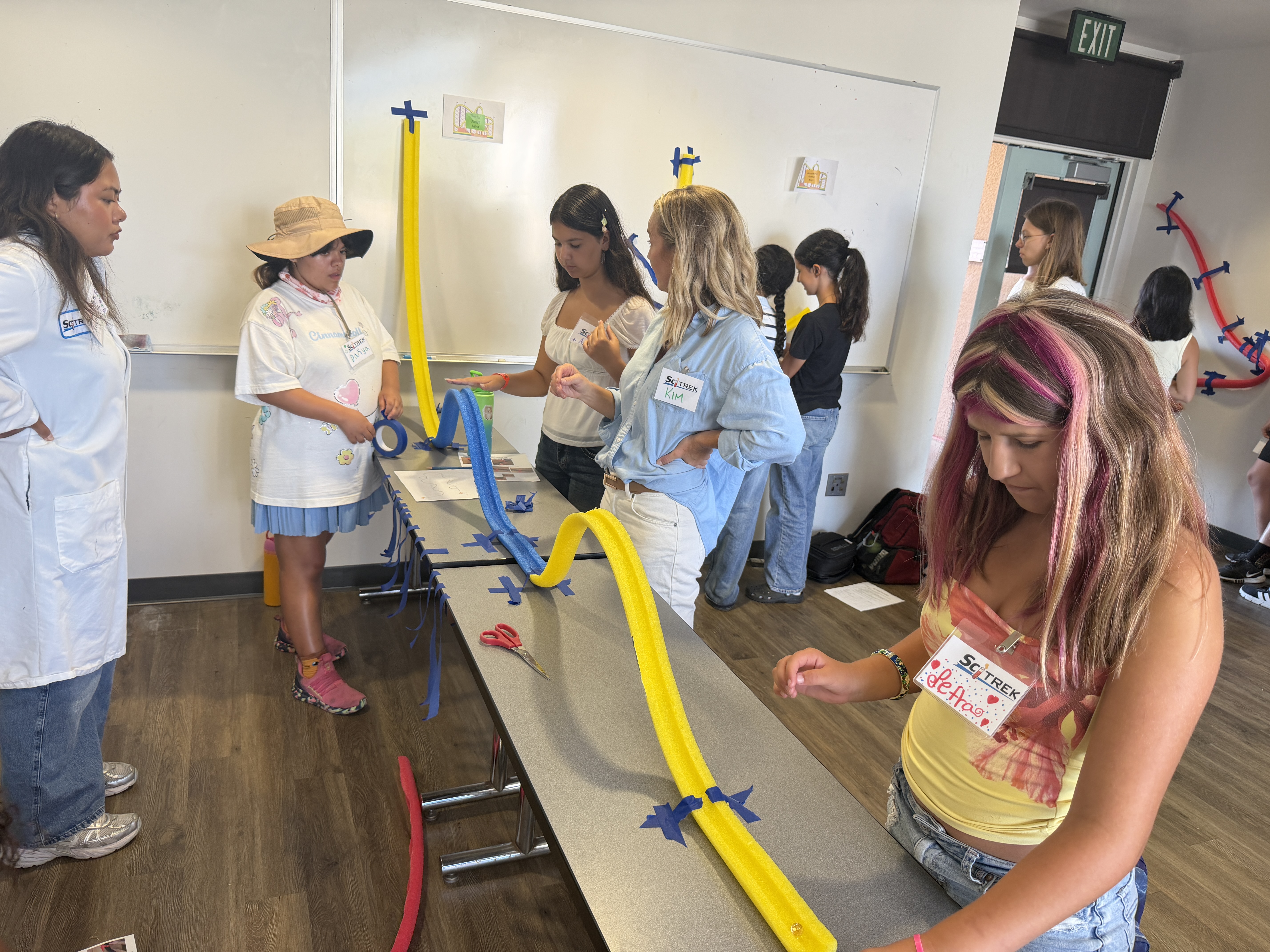
Pictured above: Middle school campers and SciTrek mentors build pool-noodle roller coasters during a summer physics activity at UC Santa Barbara. Photo by Seren Snow.
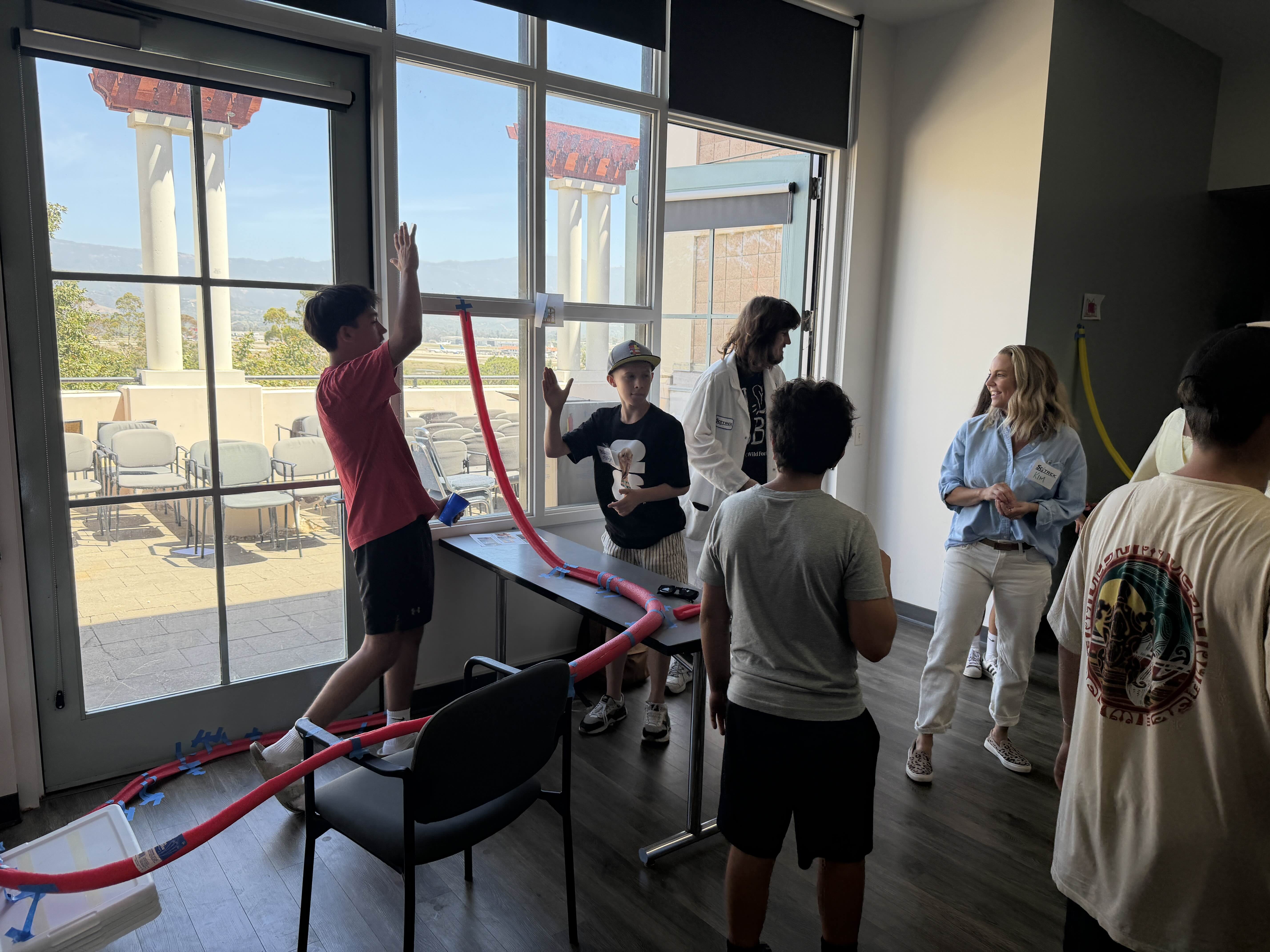
Red, blue and yellow pool noodles climbed whiteboards, curved along cabinet fronts and crossed tables inside a UC Santa Barbara classroom. Painter’s tape held the improvised tracks in place. Glass marbles waited at the top.
Some marbles completed the course. Others gathered too much speed, leaped from a turn and sent their builders back to the tape.
Reflecting on the July 24 activity, Kim Ciancio said the goal was not a flawless first run.
“What I want them to come away with is knowing how to adjust something,” she said. “That’s how the science works. There’s not just one right way to do something, and very rarely do we ever get it right the first time.”
The roller coaster challenge capped a week of physics activities in SciTrek’s summer program for middle school students. Earlier in the week, campers tested how ramp height, weight and surface friction affected motion. They formed questions, made predictions and gathered data before turning split pool noodles into courses with loops, banks, hills and drops.
By Friday morning, the room had become a laboratory of competing designs. Students crouched beside cabinet doors to reinforce a turn. Others held track against a wall, debated how much height a marble needed to clear a loop or shifted a launch point after a test failed. A curve tightened. A section moved higher. Another strip of tape went on.
The point was not to build one perfect roller coaster. It was to practice thinking like a scientist.
“We want to see students take information we’ve taught them and then utilize that to ask questions and figure out how to answer them,” said Ciancio, one of the academic coordinators for SciTrek Secondary Programs. “They ask a question, they design a way to answer it and they try to answer it. They gather data. It’s that thought process that’s important.”
Ciancio focuses primarily on middle school programming. Gulistan Tansik, senior manager of the SciTrek BioTech Secondary Program, develops and implements high school modules, including virtual programming that extends SciTrek beyond Santa Barbara County. The broader program was founded in 2010 within UC Santa Barbara’s Department of Chemistry and Biochemistry by Norbert Reich and Darby Feldwinn and serves students in grades two through 12. During the school year, SciTrek partners with classroom teachers on multiday investigations that move from observing a phenomenon to asking testable questions, designing experiments, analyzing evidence and presenting results. The summer program partners with UCSB’s Department of Recreation.
The summer schedule gave Ciancio room to lean even further into inquiry. She put the available materials in front of the campers and asked, “What could you ask?” One group wondered how many speed bumps made from pipe cleaners it would take to stop a model car. Others explored momentum or tested how changes in a ramp affected motion.
The art of not answering
Around the room, UC Santa Barbara undergraduates worked with small groups of campers. Their role was deliberately restrained.
“The main thing we try to teach our mentors is to not give answers,” Ciancio said. “It’s so hard not to because they know the answers. When in doubt, just say, ‘Why do you think that?’”
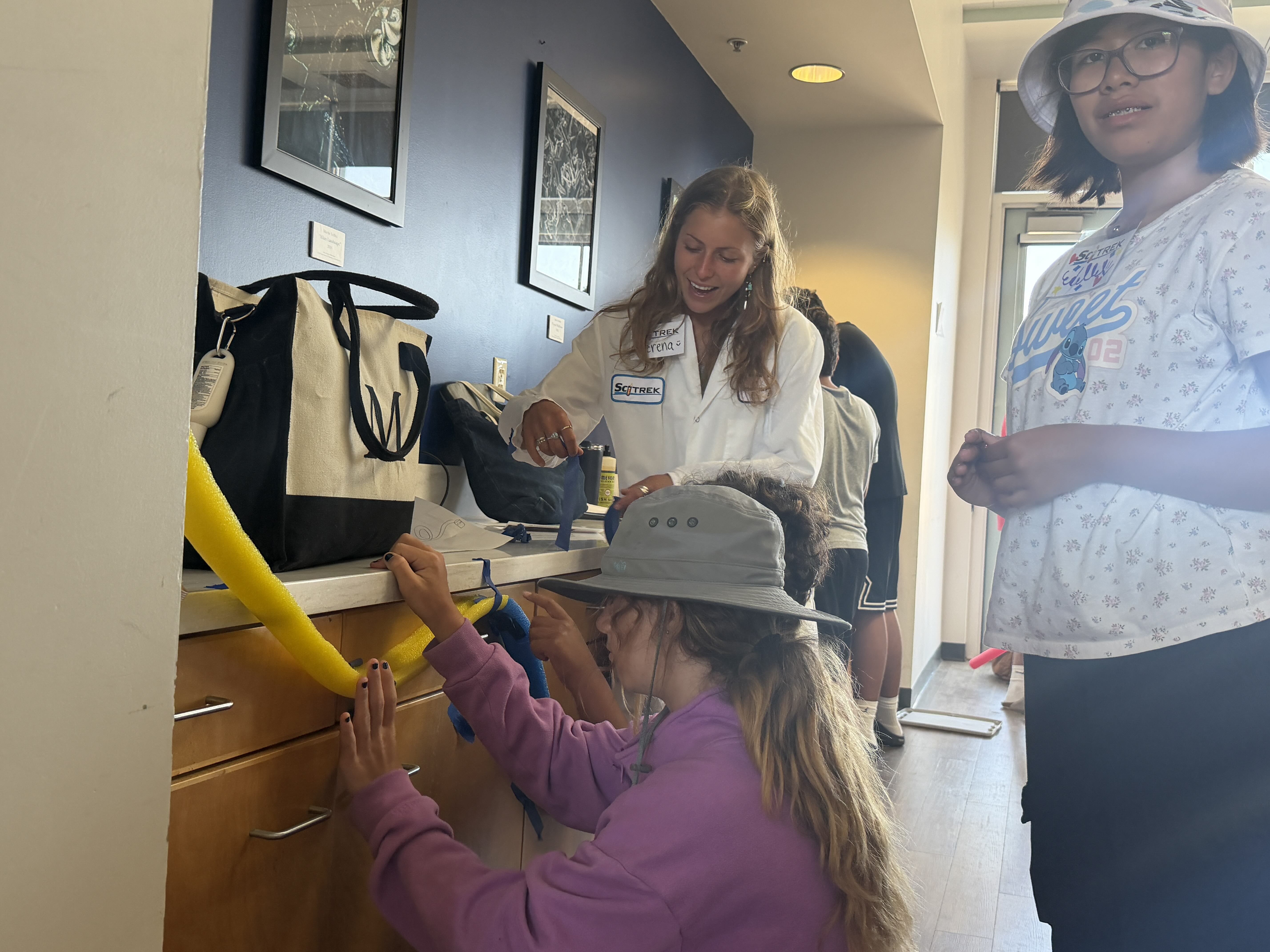
Serena Bond, a fourth-year molecular and cellular biology student with an emphasis in microbiology, began working with the program as a first-year student and now serves as a SciTrek lead mentor. She described the work as a balance between giving students enough structure to move forward and enough space to make the discovery themselves.
“Our goal is to let them deep dive into it and use their critical thinking skills to come up with questions, come up with a hypothesis and solve it on their own,” Bond said. “We’re there pretty much to guide them. We don’t really give them the answers.”
That can be difficult when a solution seems obvious to the mentor. Bond said the experience has challenged her instinct to step in and fix a problem immediately.
“One of the biggest things I’ve learned is that, in order to learn well, you have to make mistakes,” she said. “It’s not going to be on the first try.”
The previous day, Bond watched a camper repeatedly send a skateboard toward a ramp that was angled too sharply. Rather than rebuild it for him, she asked what he could change. The student reconsidered the ramp, reconstructed it and tried again.
This time, it worked.
“Seeing that light bulb effect, when they mess up and then figure out how to do it correctly, that’s probably the best feeling,” Bond said. “Getting something right after getting it wrong a few times feels incredible.”
The learning moves in both directions. Bond said SciTrek has taught her patience and given her experience managing the unpredictability of a classroom. Once, when a teacher was caught in traffic, the mentors had to run the experiment themselves and hold the attention of a room full of seventh graders.
“Patience is a huge thing in teaching,” Bond said. “I never thought I could be a teacher because I didn’t have that patience, but I think I’m learning that. Now, if I look into the future, maybe I could teach a classroom.”
Alexander Harris, an incoming fourth-year mathematics student who has mentored with SciTrek for nearly three years, said the program has strengthened his decision to pursue teaching.
Mentors try to stay hands-off while making sure students have the tools they need to pursue their own ideas. During one experiment, Harris’s group decided it needed protractors to compare how different ramp angles affected a skateboard. The materials were not in the room, so he went to find them.
“We try to be as hands-off as possible,” Harris said. “If they’re stuck, we can give them a little bit of help, but I don’t want them stuck on the same prompt for 10 minutes. They only have so much time.”
In another module on conservation of mass, students designed containers to limit the loss of mass during a baking soda and vinegar reaction. One group looked beyond the provided pieces and used the large storage bin that carried the supplies. It produced the best result Harris had seen.
“They get to design their own experiment,” he said. “There’s some pretty innovative stuff.”
Harris said SciTrek gave him practical classroom experience at a point when he was still deciding whether teaching was the right path. It also showed him that rigor and enjoyment can coexist.
“It’s a good lesson that science can be fun,” he said.
A community built around inquiry
SciTrek’s reach extends beyond a single classroom or summer week. In its June 2026 year-in-numbers report, the program reported serving 2,109 elementary and secondary students, working with 50 teachers and involving 447 UC Santa Barbara students. SciTrek also provides professional development and in-class coaching for teachers and mentors.
SciTrek is supported by a mix of federal, philanthropic and university resources. Current support includes funding from NASA and the National Institutes of Health, as well as support from the California Subject Matter Project and the Karisma Foundation. The Department of Chemistry and Biochemistry also provides office and laboratory space.
The scale depends on volunteers. A single teacher with five class sections can require roughly 30 mentors over the course of a module, Ciancio said. Lead mentors help train newer volunteers and model how to guide students with questions.
“We couldn’t do this without them,” Ciancio said. “They are the lifeblood of the whole system.”
SciTrek’s modules are designed to make the practices of science familiar, not just the vocabulary. Students are asked to develop questions, control variables, evaluate evidence and explain what the results do and do not show.
Ciancio, a former high school biology teacher, said she learned science as a set of answers to memorize. SciTrek asks students to sit longer with uncertainty.
“Allowing students the space to figure out their own answers that may not be correct, and having that be OK, is really important,” she said. “You can’t just rely on one person or one source to give you an answer and believe it.”
The language matters. A hypothesis is not simply right or wrong, Ciancio tells students. It is supported or not supported by the evidence. If the data do not support it, the experiment has still produced something useful.
“If your hypothesis wasn’t supported, you don’t just say, ‘Well, it wasn’t supported,’” she said. “Go back and try it again. Does something else work better? That’s how science works.”
The inquiry continued the following week, when campers moved from motion to microbes, swabbing surfaces, comparing bacterial growth under different conditions, discussing sources of error and creating public service announcements about disease transmission.
The subject changed. The pattern remained the same: observe, question, test, revise and explain.
Ciancio could already see the progression inside the room.
“On the first day, it’s always so quiet,” she said. “By the last day, you heard how loud it was in here, and they’re all helping each other. It’s really fun to see the connections that are made and the confidence they gain.”
Bond saw it in her group, too. At the beginning of the week, several campers seemed reluctant to spend part of summer in a classroom. By Thursday, they were asking whether she would return the next day.
“Seeing their progress from being uninterested to having some interest in what they’re doing, and being excited to come in the next day to make a roller coaster, that’s my favorite part,” she said.
For Bond, the measure of success is not whether every marble stays on the track.
“Sparking their interest in science is our main goal,” she said. “If I do that at the end of the day, I’m happy.”