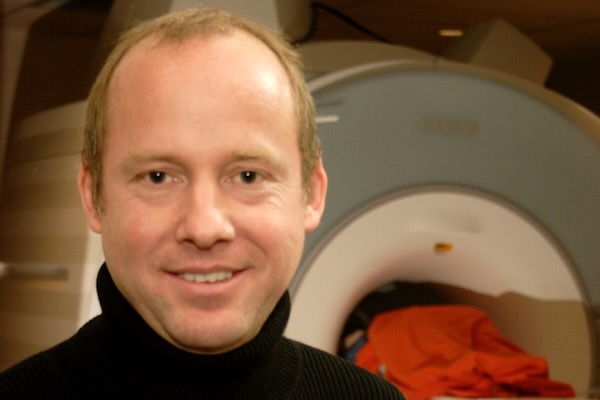
Recognition honors his pioneering — and once controversial — research using brain imaging to study how media impacts the human brain.
René Weber, a UC Santa Barbara professor whose early experiments involving video games and brain scanners were once met with deep skepticism, has been named an inaugural Fellow of the Social and Affective Neuroscience Society (SANS).
The distinction recognizes scholars who have made exceptional and lasting contributions to the field of social and affective neuroscience. Weber is one of six researchers selected for the society's inaugural class, chosen from a highly competitive pool of nominees for their roles in advancing research, fostering collaboration and strengthening the visibility of the field.
Weber holds joint appointments in UCSB’s Department of Psychological and Brain Sciences and the Department of Communication. He also serves as the director of UCSB’s Brain Imaging Center and leads the campus's Media Neuroscience Lab.
He was among the first media psychology scholars to utilize computational approaches and functional magnetic resonance imaging (fMRI) to investigate how media impacts the human brain. Today, his lab explores complex cognitive responses to mass communication, including the neural mechanisms behind moral conflict in narratives, the effectiveness of persuasion in media campaigns and the consequences of compulsive media use for mental health.
However, his methodological approach was not always widely accepted.
“In the early 2000s, I was lucky to be among the pioneers for the development and refinement of naturalistic paradigms in brain imaging studies — having participants watch videos or behave in virtual, interactive worlds while being brain-scanned, rather than executing simple, highly controlled and artificial cognitive tasks,” Weber said.
“It is fair to say that these early, often media psychological studies, were initially not well received by the cognitive neuroscience community,” he continued.
“More than 25 years since I had participants play violent video games while being brain-scanned, it is a special honor for me to be elected as one of SANS’ inaugural Fellows. In some sense, it is a confirmation of my early, controversial media psychological neuroimaging research.”
The Social and Affective Neuroscience Society and its members played a crucial role in popularizing these naturalistic paradigms, which are now widely used to understand how brains function in the real world.
Throughout his career, Weber has published four books and more than 170 journal articles and book chapters. His research is supported by national scientific foundations in the United States, Germany and South Korea, as well as private philanthropies.
Weber and the other inaugural SANS Fellows will be officially recognized at the 2026 SANS Annual Conference this April in San Diego.