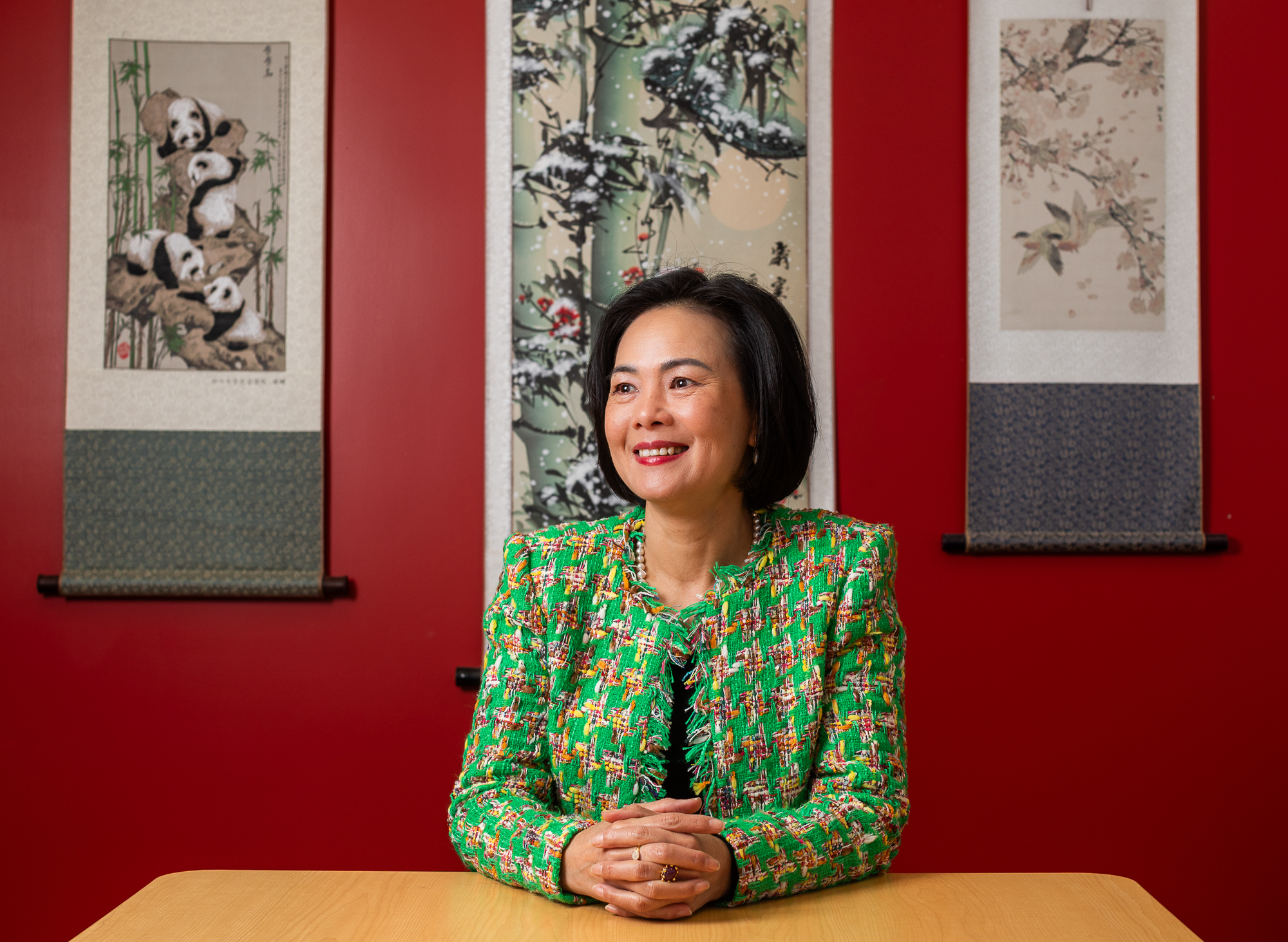
Pictured above: Thuc-Quyen Nguyen, UC Santa Barbara’s next Faculty Research Lecturer. Photo by Matt Perko.
Named UC Santa Barbara’s next Faculty Research Lecturer, Thuc-Quyen Nguyen reflects on the science, mentorship and hard-won resilience behind a career in organic materials.
When Thuc-Quyen Nguyen learned she had been selected as UC Santa Barbara’s next Faculty Research Lecturer, she felt what she still describes as surprise, happiness and deep honor.
The award, established in 1954, is the highest honor the UC Santa Barbara faculty can bestow on one of its members. For Nguyen, the recognition was meaningful not only because it came from her peers, but because it came from the community she has called home for more than two decades.
“When I say that recognition, it’s not just about me,” Nguyen said. “It’s about the team, my research team and the number of collaborators behind me.”
Nguyen holds the Essam Khashoggi Chair in Materials Chemistry, is a distinguished professor in the Department of Chemistry and Biochemistry and directs the Center for Polymers and Organic Solids. She has built a career at the frontier of organic electronic materials: carbon-based semiconductors that can absorb light, conduct electricity and be designed for applications ranging from solar cells and photodetectors to displays, light-emitting diodes, transistors, biosensors, wearable electronics and artificial skin.
But the Faculty Research Lecturer honor also arrives as a moment of reflection. It recognizes a scientist elected to the National Academy of Engineering, a widely cited leader in organic photovoltaics and a mentor whose influence now extends across continents. Nguyen’s story also begins far from any laboratory, in villages in Vietnam where electricity, clean water and enough food were not guaranteed.
“Recognition, honor and award come with responsibility,” Nguyen said. “Given the recognition and visibility, given the voice, what can you use this voice for?”
For Nguyen, the answer has always returned to young people: students, early-career scientists, women, immigrants and researchers from developing countries whose talent, she knows, can be overlooked before it has the chance to flourish.
“Thuc-Quyen Nguyen represents the very best of UC Santa Barbara: bold, interdisciplinary science; extraordinary dedication to students and early-career researchers; and a deep commitment to using discovery in service of society,” said Shelly Gable, dean of Mathematical, Life and Physical Sciences and the Susan and Bruce Worster Dean of Science. “The Faculty Research Lecturer honor recognizes not only the international impact of her work in organic materials, but also the generosity, resilience and vision that have made her such an influential member of our academic community.”
A closed door
Nguyen’s own first encounter with academic research in the United States was not an invitation. It was a closed door.
After immigrating to the United States at 21, speaking only a few words of English, Nguyen spent a year studying English as a second language in adult education programs before attending Santa Monica College. While in college, she worked several jobs, including at the Santa Monica College library, at Panda Express and in her mother’s nail salon. She later transferred to UCLA and took a work-study job washing glassware in a plant physiology lab. She watched the researchers at the bench and became fascinated by what they were doing. Eventually, she asked whether she could try research herself.
She was turned down.
“They said research is not for everybody,” Nguyen recalled. “They said I should focus on learning English.”
She did not accept that answer as final.
“I didn’t give up,” she said. “I kept knocking on many doors.”
The path between that student and the scientist now honored by her peers was not a straight one. It was shaped by pressure, adaptation and the kind of persistence Nguyen would later bring to her science.
Nguyen grew up in a family of educators, though her childhood offered little of the stability the word might suggest. Her mother taught middle school math. Her grandfather taught elementary school math. Her great-grandfather taught village children to read and write. But Nguyen’s family also lived in extreme poverty. Her father, who had ties to the former South Vietnamese government, was imprisoned for five and a half years after the war. Nguyen remembers hunger, a lack of clean water, walking long distances to school and learning to solve practical problems with almost nothing.
“How do you tell the time, what time I should cook lunch or dinner for my family, when you don’t have a watch or a clock in the house?” she said. “Or how do you make a fire on a rainy day when the branches were wet? How do you go fishing when you don’t have a fishing rod?”
She did not know it then, but those improvisations were a kind of early training.
“My creativity, I really credit back to my time in the village when I grew up,” Nguyen said.
In one of the few photographs she has from that period, Nguyen’s family stands together in Vietnam. The photo was taken three weeks before their house burned down.

Capturing sunlight
Years later, Nguyen can trace a line from that world to the questions that animate her laboratory. As a child in villages without electricity, she dreamed of capturing sunlight so she could study at night. Today, her research investigates materials that can absorb sunlight and convert it into electricity.
“I’m working toward a childhood dream,” she said, “and it turned into reality.”
“I’m working toward a childhood dream, and it turned into reality.”
Thuc-Quyen Nguyen
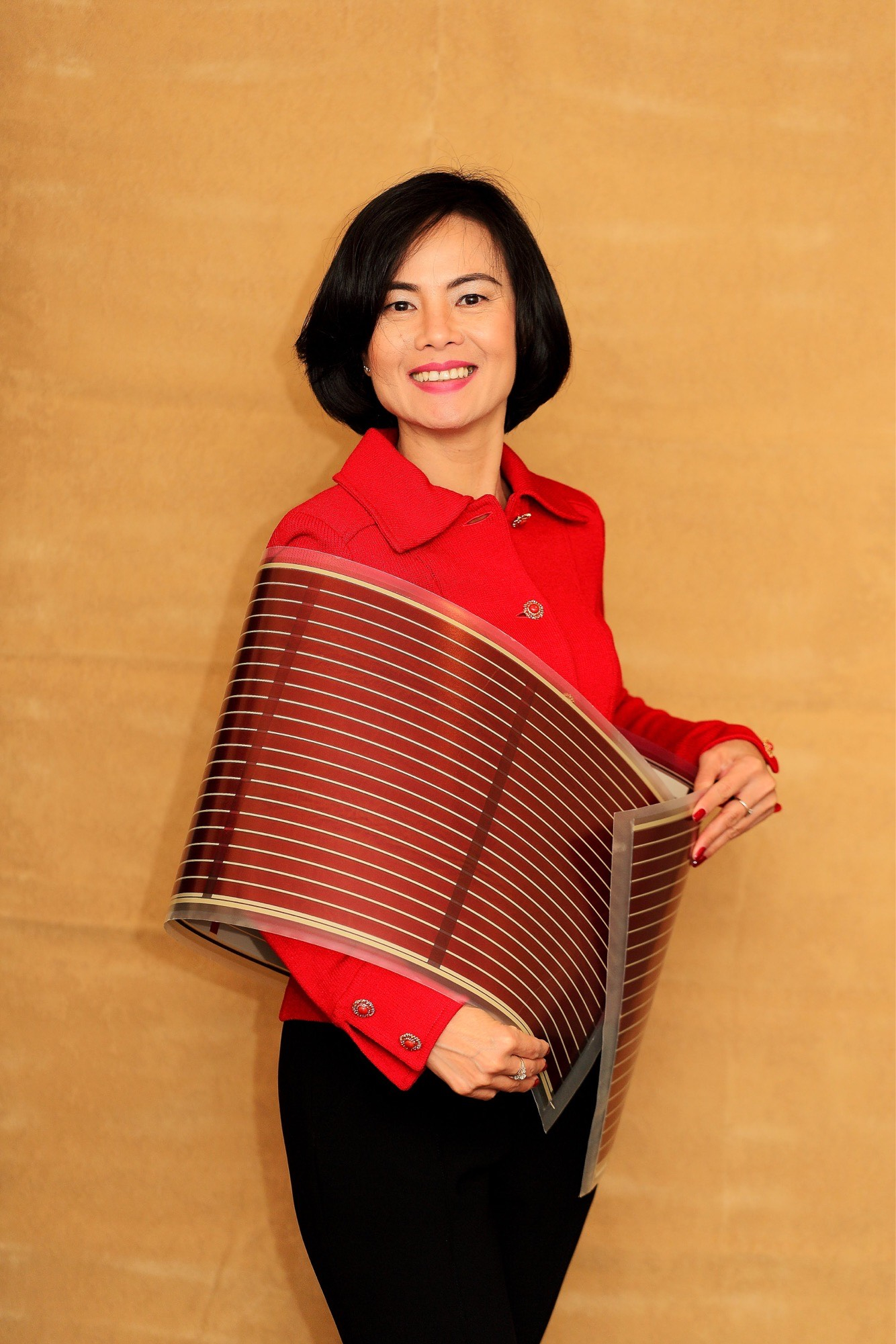
The dream now has the language of chemistry, materials science, physics and device engineering. Nguyen works with organic semiconductors, a class of carbon-based materials whose properties can be tuned by changing their chemical structure. Traditional silicon has transformed modern life, powering the electronics and solar panels that now shape the built environment. But silicon requires high-temperature, energy-intensive processing. Organic materials offer a different possibility: thin, lightweight, flexible materials that can be processed from solution at room temperature and designed for many forms and functions.
Nguyen often asks people to imagine plastic with properties that allow it to do far more than insulate. These materials can absorb light. They can conduct electricity. They can be made into thin films. They can be designed, molecule by molecule, for different applications.
“Without materials,” she said, “there is no technology.”
Her group is unusual in the breadth of its approach. Rather than stopping at one stage of discovery, Nguyen’s lab connects materials design and processing, characterization, device fabrication and device physics. The goal is not only to make something that works, but to understand why it works and why another material or device does not.
That ability to move from molecule to device has helped make Nguyen a leader in organic photovoltaics, photodetectors, transistors, electrochemical devices and biosensors. Her work asks how materials can be made more efficient, more durable, more flexible, more affordable and less environmentally burdensome.
In practical terms, the possibilities are expansive: semi-transparent solar cells integrated into windows, lightweight devices wrapped around curved surfaces, sensors that interface more gently with the body, electronics that bend instead of break. Nguyen imagines a future in which the glass surfaces of buildings are covered with organic or semi-transparent solar cells.
“I hope that, during my lifetime, I will be able to see the glass surfaces of buildings, high-rises and skyscrapers covered with these organic solar cells,” she said.
Communication became part of the science
Yet Nguyen is careful not to present science as a solitary act. Again and again, she points to the systems that made her work possible: students, postdoctoral researchers, collaborators, staff, shared facilities, UCSB’s collaborative culture and support from senior colleagues who gave advice when she most needed it.
She joined UC Santa Barbara in 2004, only 13 years after arriving in the United States. Becoming a faculty member, she said, was terrifying. English was still a daily challenge. She worked with tutors on pronunciation and communication. Her mentors helped her prepare talks. Alan Heeger, a Nobel laureate and longtime UCSB professor, gave her an early lesson she never forgot: You can have Nobel Prize-winning data, he told her, but if you cannot communicate it effectively, people will not understand its importance.
Nguyen took that seriously. Communication became part of the science.
David X. Cao, a former member of Nguyen’s group who is now a chemistry instructor and department chair at Clovis Community College, remembers that emphasis as one of the most lasting parts of her mentorship.
“What I remember best from my time in her group was her focus on ensuring that we made great presentations,” Cao said. “She trained us to look at not only each individual slide, but to make sure that the entire presentation flowed well overall by looking at the deck with the slide outline view in PowerPoint. It’s made me a better instructor myself.”
Learning through feedback
Feedback became central to Nguyen’s approach, too. Across her teaching, mentoring and research, she has made a habit of asking others to tell her what is wrong.
At conferences, she still seeks out senior scientists after her talks. She does not ask whether they liked the lecture.
“If you ask, ‘What do you think about my talk?’ they will say, ‘Great, I love it,’” Nguyen said. “As a human being, you like that, but you learn absolutely nothing from that statement.”
Instead, she asks what was unclear. What went wrong? What could be better?
As a young faculty member, she made an even more direct request of senior colleagues: If something is wrong with my work, please tell me to my face.
“They were shocked,” Nguyen said. “I said, ‘Yes, because I’m a young scientist. I’m inexperienced. But I want to be a good scientist.’”
The same philosophy shaped her teaching. Before teaching general chemistry to more than 350 students, Nguyen studied how other faculty taught the course, asked for advice, sat in on lectures and listened to online lectures on the same topics. Then, instead of waiting until the end of the quarter for student evaluations, she created her own survey after two weeks. She read the responses, summarized them for the class and explained what she could change immediately, what she could not and why.
Nguyen also stays in touch with former undergraduate and graduate students and postdoctoral researchers, seeking feedback after they have spent several years in the workforce.
“This way, I can train students accordingly and prepare them for the workforce,” she said. “I always learn by feedback.”
Teaching as transformation
That devotion to teaching reaches back to her mother, whom Nguyen still describes as one of her models. There was no child care in the village, so her mother brought Nguyen and her sisters to class. There, Nguyen watched her mother command a classroom. She remembers students listening, taking notes and returning years later with flowers.
“When I grow up, I want to be a teacher just like her,” Nguyen remembers thinking.
Her mother noticed when students were absent, found out where they lived and visited families to persuade parents to send children back to school, even during harvest season. Then she helped the students catch up in the evenings.
Years later, Nguyen’s mother sat in the back of a large lecture hall at UC Santa Barbara while Nguyen taught freshman chemistry. At the end of the lecture, Nguyen told the class about her mother’s influence. After class, students approached her mother to say what Nguyen’s teaching had meant to them.
Nguyen remembers seeing tears in her mother’s eyes.
For Nguyen, teaching is not secondary to discovery. It is another form of transformation.
“In my opinion, the research is great. You discover things,” she said. “But teaching, you see how you can transform a student. It’s amazing to watch.”
She has seen students enter her lab afraid to handle equipment and leave as experts. She has watched undergraduates arrive unsure whether research was for them, then go on to doctoral programs or scientific careers. The work, she said, is not one-size-fits-all. Each student arrives with different motivations, strengths, habits and ways of learning. A mentor’s job is to see those differences clearly enough to help each person grow.
Christopher M. Proctor, a former Ph.D. student in Nguyen’s group and now an associate professor in bioelectronics at the University of Oxford, described her as both a demanding scientist and an unusually committed advocate for the people she trains.
“Throughout my career, I have never had a stronger advocate than Professor Nguyen,” Proctor said. “She combines world-class scientific leadership with an extraordinary commitment to her students, always working tirelessly to help them succeed. Her unwavering support, high standards and genuine investment in the people around her have had a profound and lasting impact on my development as a scientist and mentor.”
Opening doors for others
Nguyen’s commitment to widening access now extends well beyond campus. She helped establish the VinFuture Foundation, a Vietnam-based international science and technology prize organization that honors research and innovation with the potential to improve people’s lives. She chairs its pre-screening committee. Nguyen said she persuaded the founders to create special prizes for women innovators and innovators from developing countries. The foundation awards a $3 million Grand Prize and three $500,000 special prizes.
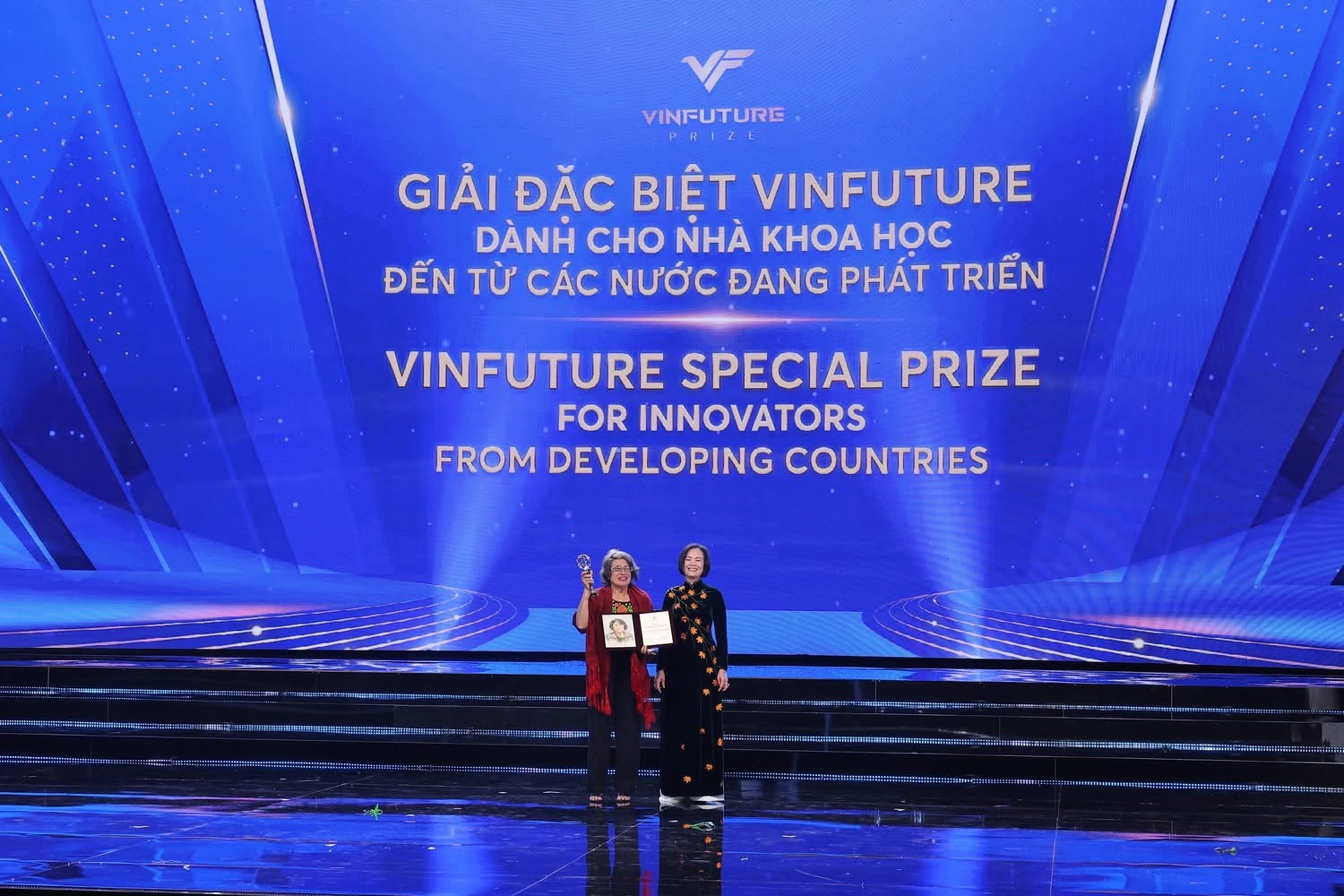
For Nguyen, those categories are not symbolic. They reflect a conviction forged from experience: that brilliance is not evenly recognized, and that opportunity often depends on whether someone is willing to open a door.
She also provides one-on-one career coaching to young scientists around the world, including people she has never met before they email her. She meets with them on Zoom, listens to their questions and offers advice.
The work is time-consuming. It is also, in Nguyen’s view, part of the responsibility that comes with visibility.
“I have worked so hard to get where I am today,” she said. “I’m not going to let whatever happened stop me from achieving my goal.”
That is the lesson she offers young people who face their own versions of doubt or exclusion. Do not give up hope. Do not let other people’s assumptions define your future. Take one step, then another. Learn English. Take the class. Transfer. Apply. Ask again. Knock on another door. Learn from others. Knowledge, she tells them, is something no one can take away. Dream big and pursue it.
“Talk is cheap,” Nguyen said. “Show people what you can do.”
The Faculty Research Lecturer honor gives Nguyen a new platform from which to tell that story, not as a simple tale of individual perseverance, but as a reminder of what science requires. Curiosity matters. So do materials, instruments, institutions, colleagues, staff, mentors, students and the courage to keep learning in public.
Looking back, Nguyen said she feels grateful for the support that helped her survive hardship and build a life in science. She tries to pass that gratitude forward.
“You can look at a glass half empty or half full,” she said. “I always choose to look at half full.”
For Nguyen, the connection between childhood and career is not symbolic alone. The girl who once imagined capturing sunlight so she could study at night now leads a research group working on materials that can absorb light, conduct electricity and help shape the future of renewable energy.