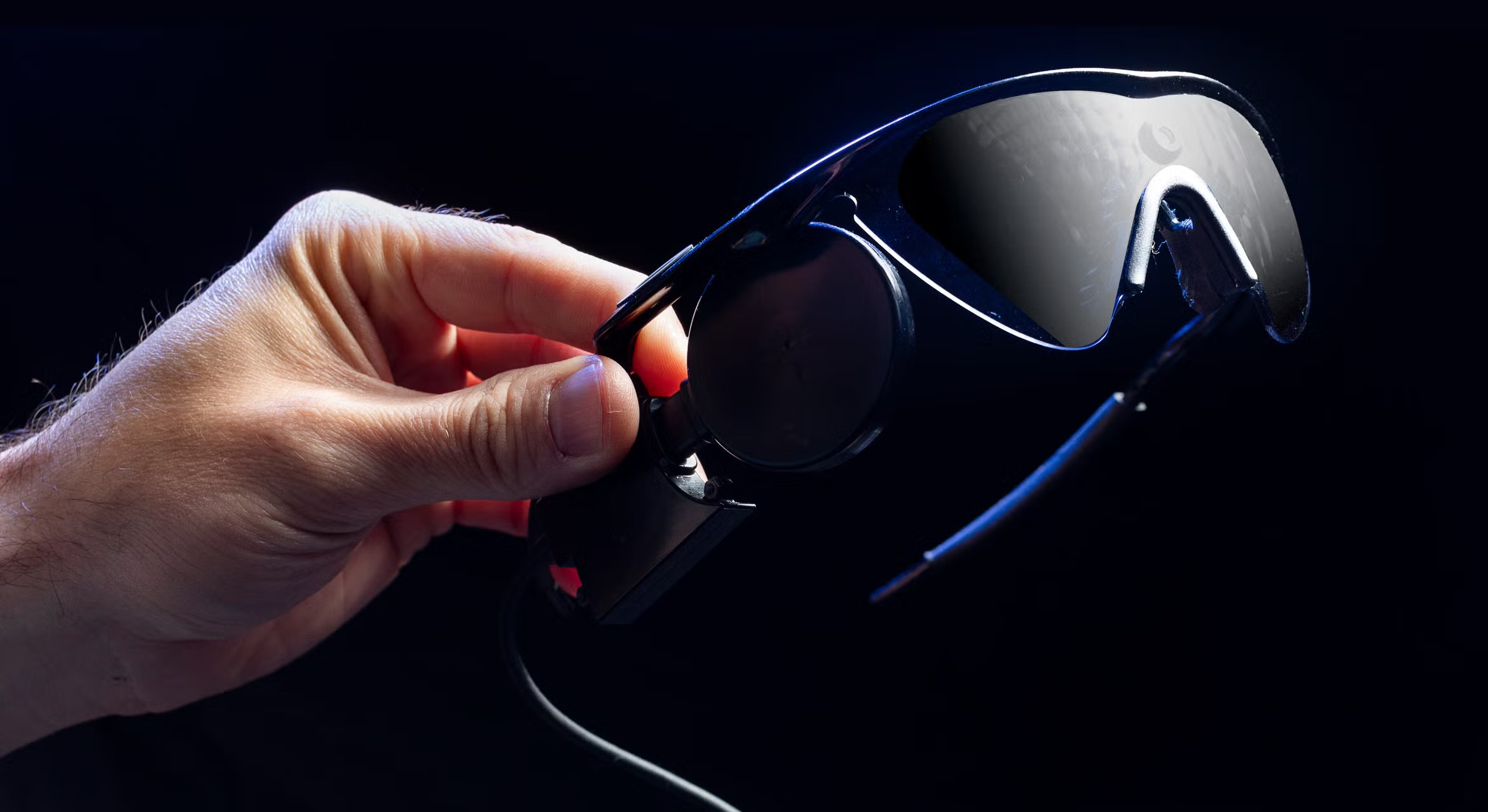
Pictured above: UCSB’s Michael Beyeler is using artificial intelligence to improve visual cortical prostheses, or “bionic eyes.” Photo by Matt Perko.
A deep-learning model helped researchers more precisely control brain responses produced by a visual cortical prosthesis.
Researchers from UC Santa Barbara and two international partner institutions have demonstrated how artificial intelligence could make future visual cortical prostheses more precise, predictable and responsive to the individual using them.
Michael Beyeler, an associate professor in UC Santa Barbara’s Department of Psychological & Brain Sciences and Department of Computer Science, and his collaborators used a deep-learning model to design patterns of electrical stimulation for electrodes temporarily implanted in the visual cortex of a blind participant.
The proof-of-concept study, published in Neuron, is part of a broader effort to develop visual cortical prostheses that communicate more effectively with the brain.
Researchers trained a deep neural network to predict patterns of brain activity produced by different electrical stimulation settings. They then used the model to identify stimulation patterns most likely to produce a desired neural response.
The AI-designed patterns reproduced targeted patterns of brain activity more accurately and required less electrical current than other approaches. Neural activity recorded from the participant’s brain also predicted what he perceived more effectively than the electrical stimulation settings alone.
“A useful visual prosthesis cannot rely on a fixed recipe,” Beyeler said.
The model also incorporated measurements of the participant’s resting brain activity, allowing the stimulation design to account for changes in the brain’s state. Beyeler and his colleagues see that adaptability as an important step toward visual prostheses designed around the responses and needs of individual users.