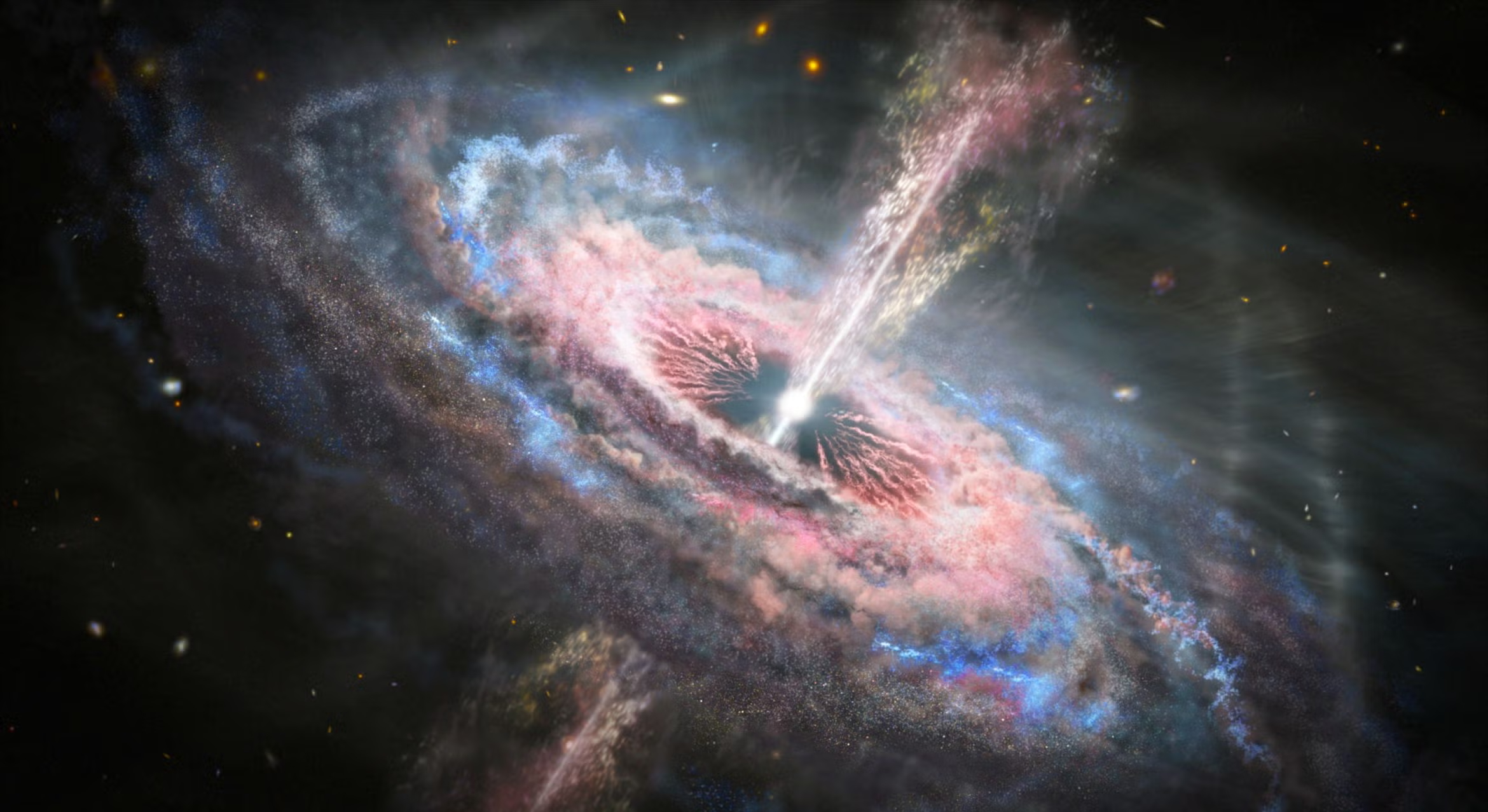
Pictured above: An artist’s concept shows a quasar powered by matter falling into a supermassive black hole. Image courtesy of NASA, ESA and Joseph Olmsted (STScI).
Physics professor Joseph Hennawi is part of an international team identifying ancient quasars that offer clues to how supermassive black holes formed in the early universe.
An international team of scientists, including UC Santa Barbara physics professor Joseph Hennawi, has discovered 31 of the most ancient quasars ever found. Two of the objects are the earliest quasars yet observed, shining when the universe was only about 670 million years old.
Quasars are among the brightest and most energetic objects in the universe, powered by supermassive black holes at the centers of galaxies. Their light allows scientists to study some of the earliest periods in cosmic history.
“These objects provide the best clues for understanding how supermassive black holes form,” Hennawi said. “These monsters — weighing billions of times the mass of our sun — somehow already existed when the universe was in its infancy.”
The discoveries were made using data from the European Space Agency’s Euclid space telescope, which is surveying vast areas of the sky from above Earth’s infrared haze. The findings mark a major advance in the search for quasars from the first billion years of the universe.