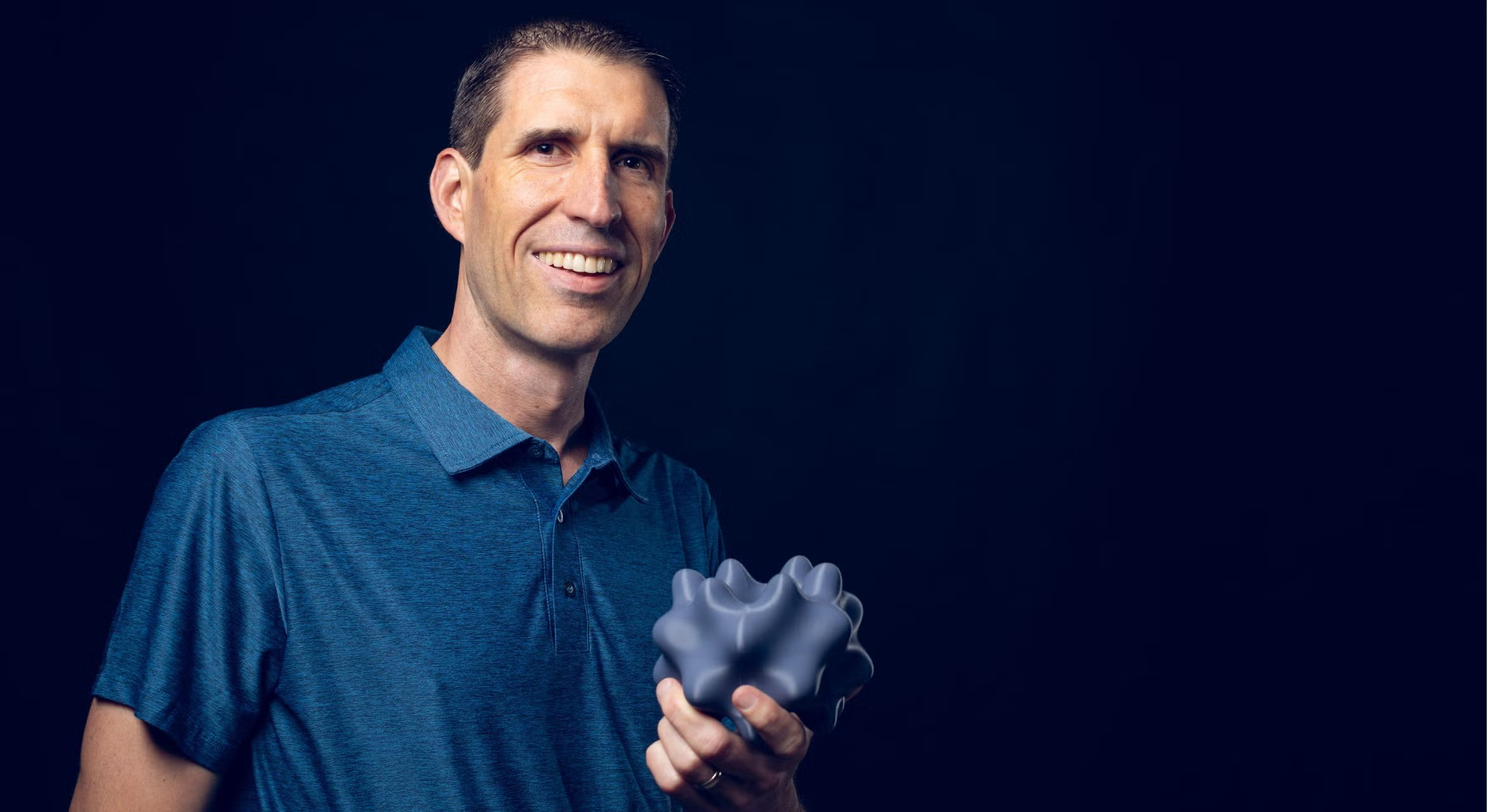
Pictured above: Paul Atzberger is designing AI that sees the world more like a geometer. Photo by Matt Perko.
UC Santa Barbara researchers are developing geometric neural operators that enable artificial intelligence systems to analyze how points connect to form shapes, surfaces and physical structures.
Many AI systems can identify familiar patterns without accounting for how individual data points form a coherent object. Paul Atzberger, a professor of mathematics and mechanical engineering, is working with mathematics graduate student Blaine Quackenbush to address that limitation through geometric neural operators.
“We’re leveraging concepts from mathematics and differential geometry so these AI algorithms see the data as more than just a collection of floating points,” Atzberger said.
The team’s approach enables models to learn geometric properties such as curvature directly from data represented as point clouds. This can make models more robust to noise and to different ways of sampling the same shape. Potential applications include modeling heat transfer, computer-aided design, lidar processing and simulations in physics, biology and engineering.
The group has released version 2.0 of its easy-to-use, open-source Python package, along with pretrained models, examples and technical papers on its GitHub page.