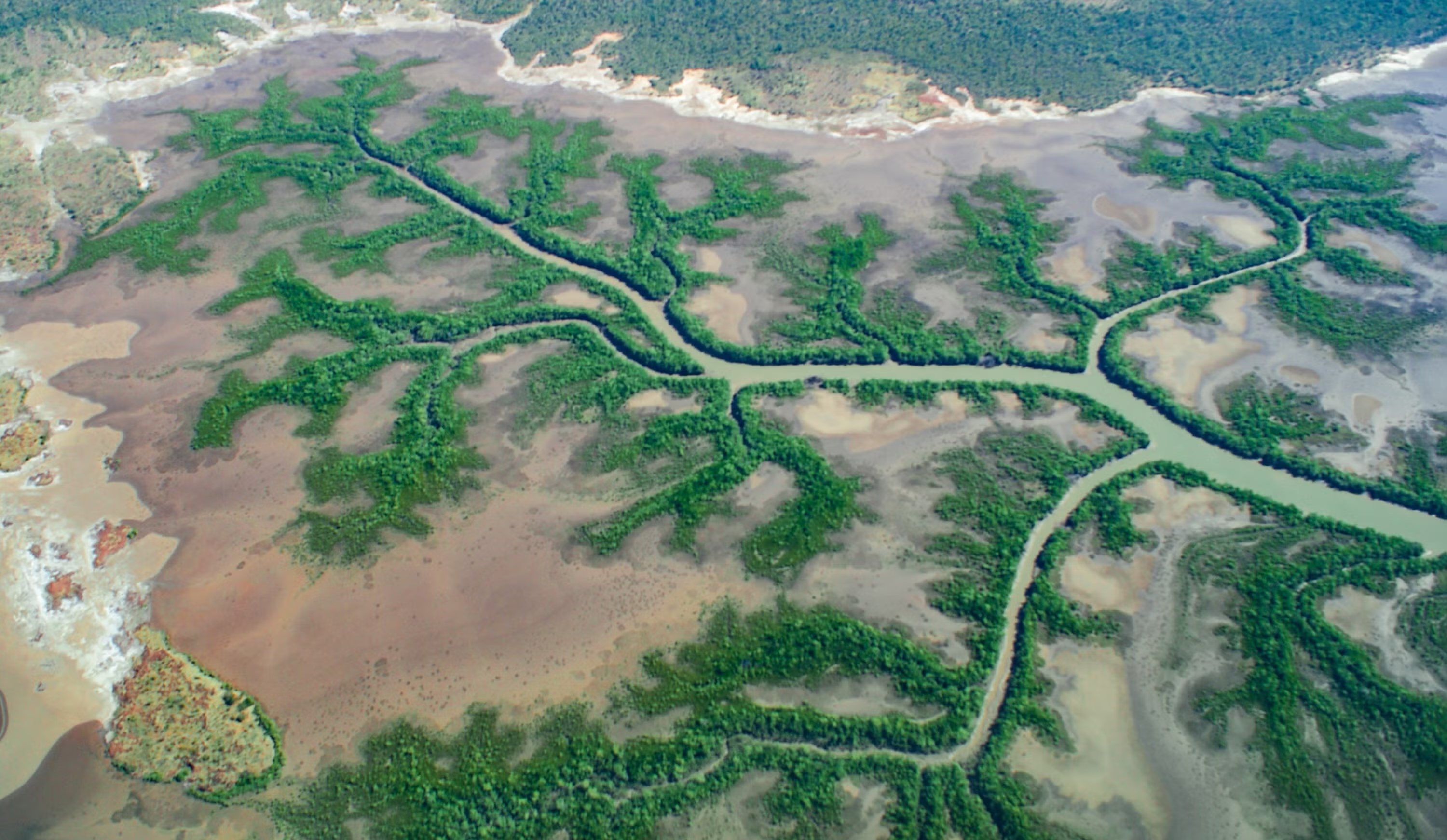
Pictured above: Erosion creates self-similar, repeating patterns across a branching river landscape. Image via iStock.
The UC President’s Postdoctoral Fellow is working with mathematics chair Björn Birnir to develop a rigorous theory connecting fractals, optimal transport and landscape evolution.
UC Santa Barbara mathematician Therese Basa Landry is using the repeating geometry of fractals to investigate how erosion shapes landscapes over time.
Therese Basa Landry, a 2026 UC President’s Postdoctoral Fellow in UC Santa Barbara’s Department of Mathematics, is working with Björn Birnir, professor and department chair, to develop a rigorous mathematical theory of erosion.
“With Bjorn, I’ve gotten a chance to develop mathematical models for understanding how some of these phenomena happen in nature,” Landry said.
Fractals are self-similar patterns that recur at different scales. They appear throughout nature in river networks, mountain ranges, trees, lightning, waves and the branching structures within the human body.
Landry and Birnir’s work connects erosion to optimal transport, a mathematical framework for determining the most efficient way to move mass from one location to another. In a landscape, erosion moves soil and rock downhill through watersheds, gradually producing branching forms that repeat at different scales.
The researchers will build on earlier work in turbulent flows, landscape evolution and mathematical models of erosion. They plan to collaborate with researchers at UC Santa Barbara and Los Alamos National Laboratory to test the theory against real-world phenomena.
The long-term goal is to improve understanding of how landscapes evolve and strengthen predictions of rain- and flood-driven hazards, including landslides and debris flows.
Landry, who began her professional career as a high school mathematics teacher, also hopes to encourage more Asian American and Pacific Islander students to pursue careers in mathematics.