
Community Spotlight
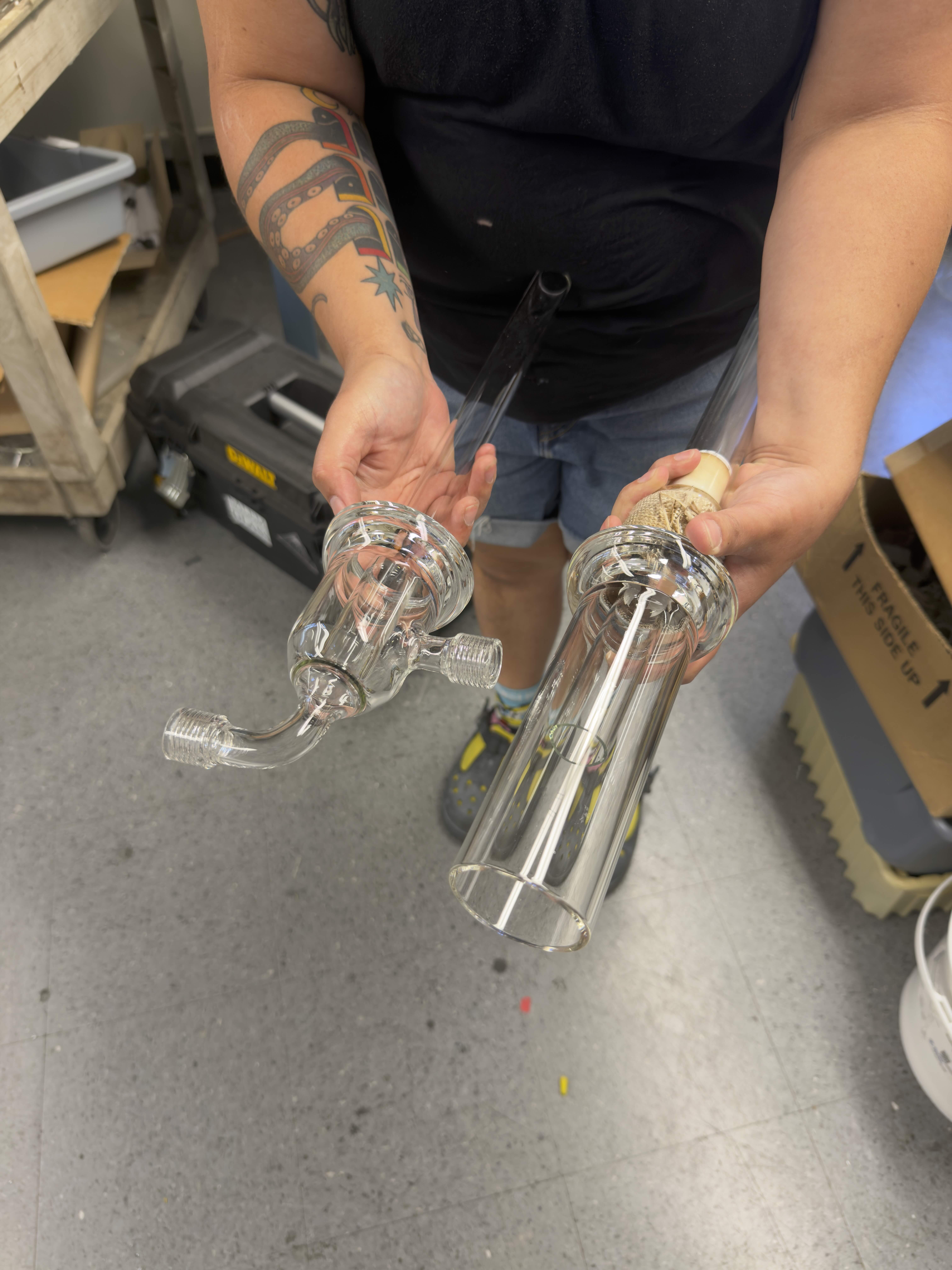
Pictured above: Corina Guerra in the Department of Chemistry and Biochemistry Glass Shop.
From repairing broken Schlenk lines to designing custom apparatus, Corina Guerra brings an artist’s eye and a problem-solver’s precision to scientific glassblowing at UC Santa Barbara.
Corina Guerra, glassblowing facility manager for the Department of Chemistry and Biochemistry, repairs essential apparatus, modifies commercially available glassware and works with researchers to develop custom pieces for experiments across campus.
Her path to UC Santa Barbara began not in a traditional science program, but in art. Today, she brings together technical precision, hands-on creativity and an understanding of how researchers use specialized equipment. Her work helps reduce laboratory downtime, extends the life of scientific glassware and gives researchers access to apparatus designed for their specific needs.
How did you first become interested in scientific glassblowing, and what path brought you to UC Santa Barbara?
My background is actually in art rather than STEM. I began working with glass in 2008 while studying at Alfred University, where I focused on furnace glassblowing with soda-lime glass. It was the kind of artistic glassblowing people might recognize from shows such as Blown Away.
During my senior year, I began experimenting with borosilicate glass and flameworking techniques. I also attended the Glass Olympics, which was hosted that year by Salem Community College in New Jersey. I had not known that scientific glassblowing existed as a profession, and I was fascinated by the complicated apparatus in the school’s display cases.
After earning my BFA from Alfred, I enrolled in Salem’s scientific glass technology program. I later worked in production at Chemglass Life Sciences, where I developed the speed, consistency and technical skills needed to fabricate scientific glassware. I then became a research glassblower at 3M, producing custom apparatus, repairing damaged pieces and supporting researchers at facilities around the world.
In 2023, I met UCSB’s previous glassblower, Richard Bock, at a scientific glassblowing conference. He told me he was planning to retire and encouraged me to apply. One search of Santa Barbara was enough to convince me. I joined UCSB in early 2024, and I could not be happier with the move.
What kinds of projects typically come through the Glass Shop?
Most of the work I do here involves repairs. A researcher may break a Schlenk line or another crucial piece of laboratory glassware and need it repaired quickly so an experiment can continue with as little downtime as possible.
Having an on-campus Glass Shop also allows students and researchers to modify commercially available glassware or design apparatus tailored to a particular experiment. Most of my work supports research, though I occasionally modify or fabricate pieces for teaching.
I work most often with graduate students, doctoral students and postdoctoral researchers. Sometimes they know exactly what they need. Other times they arrive with a problem or a rough concept, and we work together to determine what is possible.

What does the process look like when a researcher brings you an idea or problem?
It is very collaborative. Researchers understand their experiments, but they may not know how glass fabrication works, which components are available or where the physical limitations of the material lie.
My job is to ask questions about how the apparatus will be used, which dimensions are critical and what conditions it must withstand. We often work through several drawings. I keep a small whiteboard in the shop specifically for those conversations.
There is also usually a kind of show-and-tell process. I may bring out different tubing sizes, joints or components so the researcher can see the available options. If I do not have a component on hand, I can pull up examples online and help identify an alternative design. The goal is to turn the researcher’s idea into something that can be fabricated safely and function as intended.

What do you wish more people understood about scientific glassblowing?
Scientific glassblowing is a rare and necessary art and science. There are fewer than 600 scientific glassblowers working in the United States, and many university glass shops have closed over time.
Glass remains essential to many areas of research because it is nonreactive with most chemicals, and materials such as borosilicate glass and fused quartz can withstand high temperatures. Scientific progress has long depended on glassblowers’ ability to create the apparatus researchers need.
Repair can also have an environmental benefit. Borosilicate laboratory glass and fused quartz generally cannot enter standard container-glass recycling streams in the same way bottles and jars can. Repairing a damaged piece can extend its useful life and help keep specialized glass out of the waste stream.
UCSB is fortunate to have an active Glass Shop and a scientific community that understands the value of the service.
What do you enjoy most about the work?
I get to make things with my hands and work with fire every day.
As an artist, I always struggled with the idea of creating objects that would simply sit around and be looked at. Even in art school, I gravitated toward functional work because I wanted the things I made to have a purpose.
Scientific glassblowing gives me that purpose. The pieces I fabricate and repair are used in experiments and help move research forward. I may not be the person directly pushing the needle with the science, but I am supporting the people who are. I find that deeply fulfilling.
The Chemistry and Biochemistry Glass Shop provides consultation, fabrication and repair services for research and instructional needs across UC Santa Barbara.