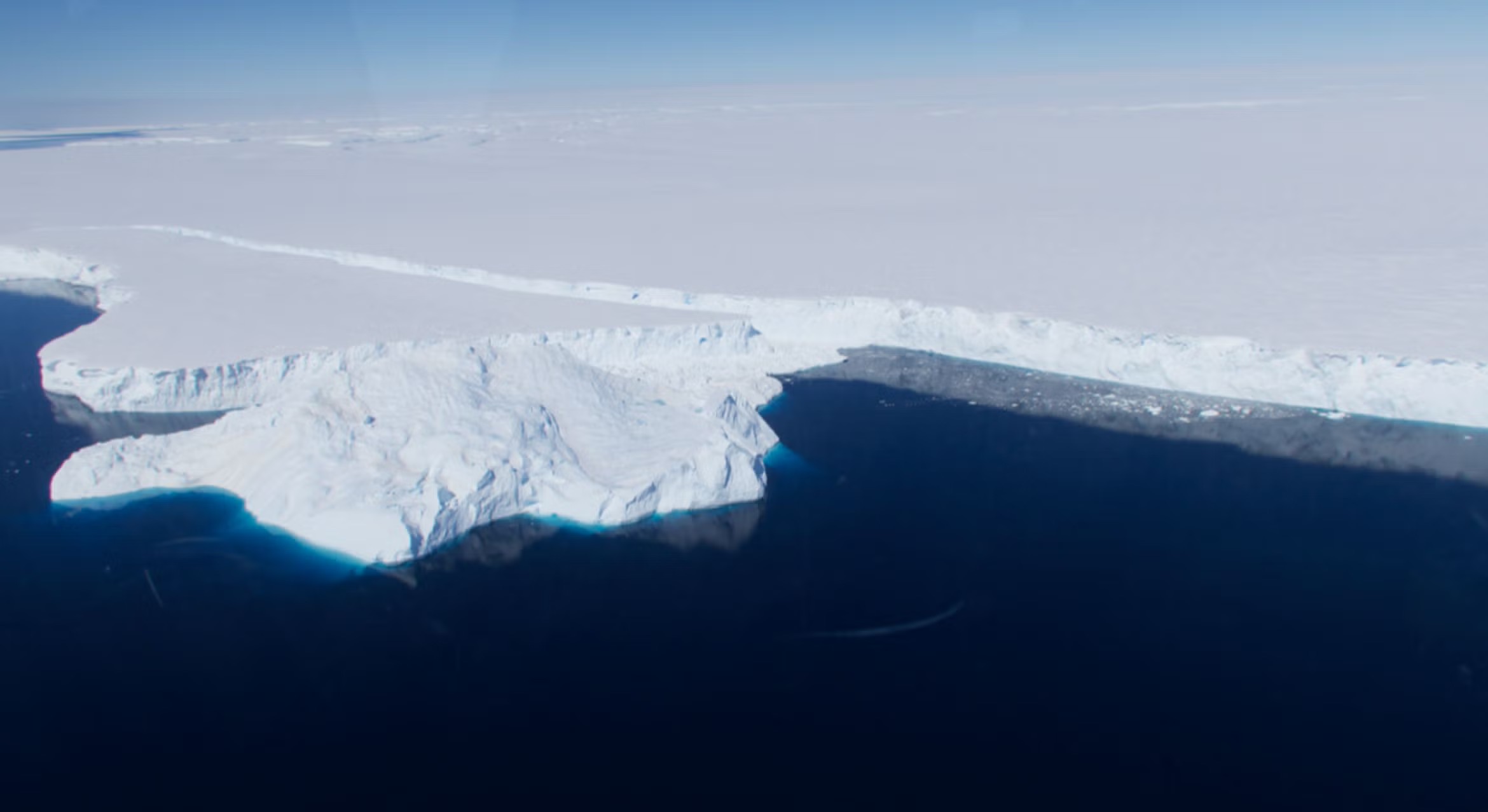
Pictured above: The Totten Ice Shelf contributes to ice loss in East Antarctica, while increased snowfall from 2021 to 2023 temporarily offset Antarctic ice loss. Photo by Yoshihiro Nakayama.
Research finds that unusual snowfall from 2021 to 2023 was linked to warmer tropical oceans rather than a new long-term trend.
Antarctica’s temporary gain in ice-sheet mass between 2021 and 2023 was driven by exceptional snowfall linked to natural climate variability, rather than evidence of a new long-term trend, according to research led by UC Santa Barbara climate scientist Qinghua Ding.
Qinghua Ding, a professor in UC Santa Barbara’s Department of Geography, studies large-scale climate patterns and the connections between tropical and polar climate systems.
“Our study identifies the mechanisms responsible for this recent slowdown in melting and shows that it could be temporary,” Ding said.
The Antarctic Ice Sheet has experienced net mass loss for decades, particularly in West Antarctica. Between 2021 and 2023, however, unusually heavy snowfall in parts of East Antarctica temporarily added mass quickly enough to offset losses elsewhere on the continent.
Using observations and climate-model experiments, the researchers traced the additional precipitation to persistent warming in the tropical warm pool of the western Pacific and eastern Indian oceans. That warming generated a poleward-propagating atmospheric wave pattern that favored increased moisture transport from the midlatitude Indian Ocean toward East Antarctica.
The study, published in Nature, found that similar multiyear tropical warming episodes recur in historical observations and simulations. The recent Antarctic mass gain therefore appears to be temporary rather than evidence of a new long-term trend.
Understanding these short-term fluctuations is important because the Antarctic Ice Sheet remains the largest source of uncertainty in projections of long-term sea-level rise.