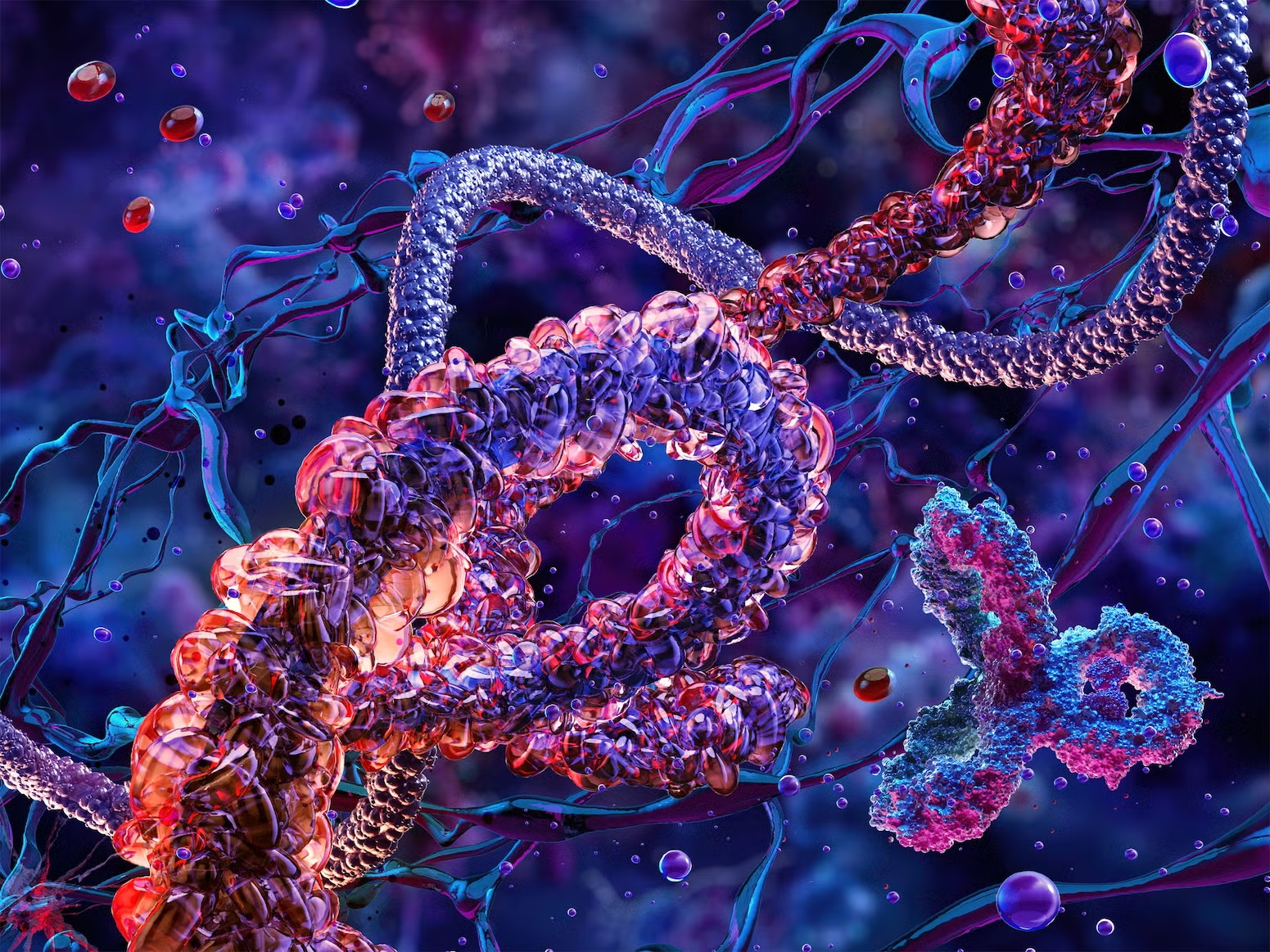
Pictured above: A scientific illustration shows 3D protein structures formed by amino acids and peptides. Image via iStock / quantic69.
Chemistry and biochemistry professor Joan-Emma Shea collaborated on AI-based models that may help researchers study protein assembly linked to neurodegenerative disease.
UC Santa Barbara researchers have developed two new computational models that use artificial intelligence to predict how certain proteins assemble into solid-like fibrils or liquid-like droplets inside cells.
The collaborative research includes contributions from Joan-Emma Shea, a professor in the Department of Chemistry and Biochemistry, and M. Scott Shell, a professor in the Department of Chemical Engineering. Recent chemical engineering doctoral graduate Sam Lobo designed the models.
The models, called amyloid-predict and LLPS-predict, are designed to estimate whether a protein sequence is likely to form amyloid fibrils or undergo liquid-liquid phase separation. Both processes are important for understanding intrinsically disordered proteins, whose disrupted assembly has been associated with conditions such as Alzheimer’s disease, Parkinson’s disease and amyotrophic lateral sclerosis.
“One challenge in this field of aggregation-based neurodegenerative disorders is that we don’t have reliable model systems that you can test and characterize at the bench, or screen therapeutics against,” Shell said.
The models give researchers a new way to scan the human proteome and prioritize proteins or regions that may warrant further study as potential therapeutic targets.